
WTF, wasn’t crypto dead?

Wait wasn’t crypto dead? ⚰️
Don’t worry, we were confused too.
This week, we decided to look at the rise of Bitcoin and question why it is that after FTX and Binance collapsed, we are still seeing crypto grow. The answer is we don’t know. In part, it’s because the sector is finally getting some form of regulation. It’s also a result of crypto’s multi-faceted nature. Or maybe it’s just a meme we like to bring back every so often.
Our take? Maybe it’s a little bit of everything. Stick around to find out 👀
Welcome again to ConteNido, your gateway to the inner workings of Nido Ventures—and the best place for all the tech world gossip. As every week, we bring you careful research, updates from our fund, and all the news relevant to entrepreneurship.
So keep on scrolling, keep on learning, and don’t forget to subscribe 😉
Inside Nido: What we are doing
🚨 Don't forget to apply to our Inaugural Nido Fellowship
Nido Ventures is excited to announce applications are now open for our inaugural VC Fellowship. The Nido Fellowship is a part-time opportunity for current undergrad students to work directly with the Nido Investment Team.
From investment research to deal sourcing, fundraising, and more, the Fellowship is designed to provide an unparalleled experience focused on learning the business of Venture Capital and backing the next generation of cross-border tech innovation.
If interested, applications are open through March 31.
Apply today to join the Nido: https://lnkd.in/eZGfa997
🎧 Our Co-Founding partner was featured in the Mujer Campante podcast by Sonia Ruseler
Interested in working for a Nido Portfolio company?
Arkham
Plenna
Financial and Data analyst (send resume to nramirez@soyplenna.com)
In the Know with Nido: What we are reading
🇺🇸 The Biden administration has declared war on Apple—or at least started a great antitrust lawsuit against the tech giant. The Department of Justice is officially accusing the company of using its flagship product, the iPhone, as a means to unfairly maintain users. The lawsuit itself, questions Apple's practices around innovation and market competition, including the suppression of "super apps," restrictions of cloud-gaming apps, prohibition of third-party messaging apps from accessing carrier networks, limitation on third-party smartwatch functions, and denial of access to universal digital wallets—all things under the sun except a monopoly on selling Steve Jobs merch. (VOX)
📊 In a surprising remark, Mohamed El-Erian, Allianz's chief economic advisor, made the case for keeping interest rates at their current high levels. In an interview with Bloomberg, he suggested postponing rate cuts by a few years to avoid reigniting inflationary pressures in the country, particularly noting that the desirable inflation rate for economic stability is now above 2%, influenced by supply chain issues, a green energy transition, and the tight labor market. (Business Insider)
👗 Fast-fashion giant Shein just announced an ambitious program to sell their logistical know-how to other companies. The plan, announced by Executive Chairman Donald Tang, is called "supply chain as a service," and intends to offer the company’s supply chain infrastructure and technology to external brands and designers. This would enable them to use Shein’s system to test new fashion items in small quantities and monitor their consumer popularity through a single interface. (Wall Street Journal)
📈 After many years of build-up, the online forum website Reddit successfully IPO’d in the NY stock exchange. On their first day of trading, the company’s shares surged 48%, indicating renewed investor interest in IPOs from high-potential but likely unprofitable companies. Most of Reddit’s language around the IPO centered on portraying itself as a platform selling data for AI training purposes—including a recent data licensing agreement with Google valued at approximately $60 million annually. (Financial Times)
🧠 Neuralink, Elon Musk’s brainchild, does it again! (Do you get it? brainchild? Thank god we are VCs and not comedians). The company announced its first implant patient, Noland Arbaugh, was able to play chess using only his mind and a Neuralink implant. Arbaugh, who had the chip implanted in January, is paralyzed from the shoulders down and is slowly gaining the ability to operate a computer using his mind alone. (Bloomberg)
🎢 It’s ups and downs in the world of semiconductors. On the one hand, Intel just received nearly $20 billion in grants and loans from the Biden administration to build two new factories and modernize an existing one. On the other hand, five key suppliers to the Arizona project have delayed the construction of factories in the state. The suppliers in question are LCY Chemical, Solvay, Chang Chun Group, KPPC Advanced Chemicals (Kanto-PPC), and Topco Scientific, all of which specialize in making chemicals or specific materials used for semiconductors. (Reuters)
💻 It seems like we can’t have a week without Nvidia making the news. Now, the world’s hottest tech company just announced its next-generation chip for an AI-centered world. The chip in question is called Blackwell and has a whopping 208 bn transistors—a major increase from the 80 bn in Nvidia’s most recent chip: the H100. Quite crucially, Blackwell is meant to be twice as powerful as the H100 when it comes to training AI models. (Bloomberg)
🪖 Speaking of AI, Microsoft is also heating the competition. In an aggressive move, the company just hired Mustafa Suleyman to spearhead its consumer AI business. Suleyman was the cofounder of DeepMind, a startup acquired by Google that now serves as the company’s overall AI research and development platform when it comes to AI. As a part of the deal, Microsoft also hired all of the employees in Suleyman's startup: Inflection AI. (Bloomberg)
💰 The Browser Company, creators of the Arc browser, has secured $50 million in funding at a valuation of $550 million, led by Pace Capital. With a total of $128 million raised from notable investors, the company aims to revolutionize web browsing with its distinctive features and AI-enhanced search capabilities. Despite facing scrutiny over potential impacts on web traffic and journalism, and questions regarding their monetization strategy, The Browser Company is ambitiously striving to redefine the internet experience. (Techcrunch)
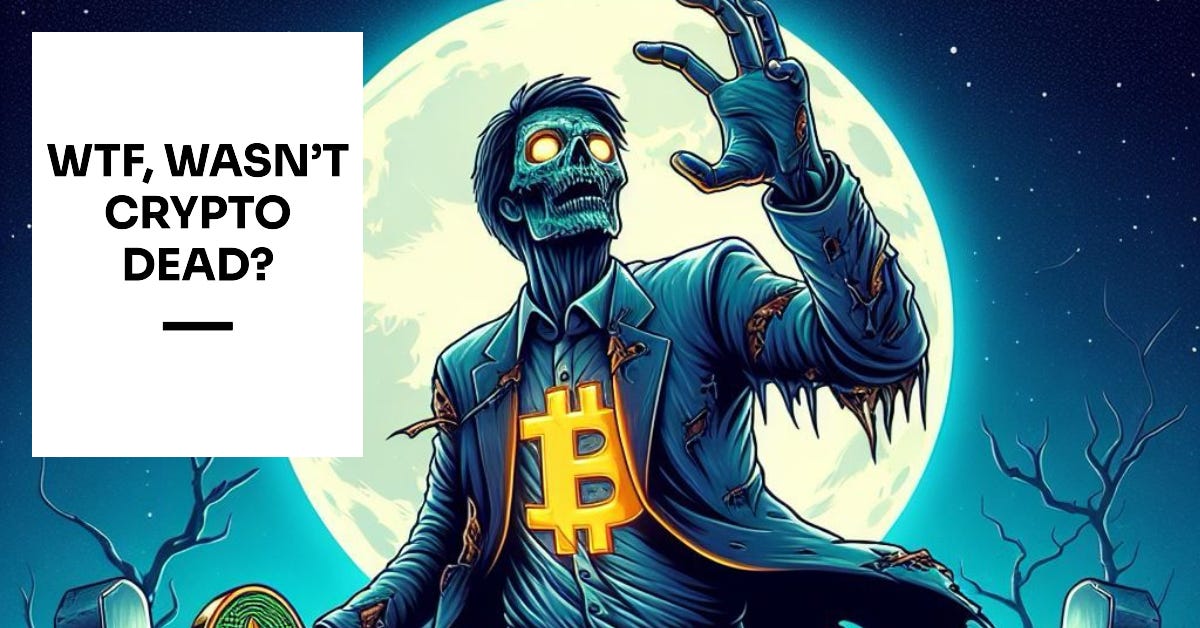
The world of crypto is, once again, the talk of the town. Most of it comes from a single event. In a momentous feat this month, Bitcoin reached a value of over $69 thousand, breaking its glass ceiling, and regaining trust amongst fanatics—some of which now herald an inevitable rise to $100 thousand per Bitcoin.
And now, Bitcoin’s triumph spreads across the world.
Rival coins like Ethereum also saw their values jump from some $2,400 to over $4 thousand in just three months. Coinbase, a crypto stock exchange and one of the only crypto-related public companies, had the value of its shares grow from $128 to $255. God, even meme coins like DogeCoin doubled in value since the year began.
Yet less than a year ago, the market for crypto was in quite a different state.
In the US, a number of investigations by the Securities and Exchange Commission (SEC) targeted large crypto exchanges like Coinbase and Binance (more on The Atlantic). Speaking of Binance, the company became subject to one of the largest inquiries on fraud, resulting in fines of $4.3 bn (more on Wired). And while we are speaking of fraud, we cannot ignore the fall from grace of FTX which went from having its CEO in Time’s magazine to being found guilty of looting $8 bn from clients (more on the New York Times).
All this drama resulted in an utter collapse of the cryptosystem. Bitcoin, then on a path to reach over $70 thousand in value, collapsed to $16 thousand. And thus, a year-long crypto winter was born.
We then have a contradiction. In 2023, everyone thought crypto was dead. In 2024, optimism is starting to emerge. Who are we to trust?
Perhaps, it’s better to start with the immediate question. How could crypto come back from the grave? Usually when two top companies in a sector are found guilty of fraud, and assets fall to a third of its value, that is enough of an indicator for investors to stir away.
Well, in a weird way, the world of crypto is quite the opposite. The crackdowns against Binance and FTX actually served a clear goal: they demonstrated that crypto could be regulated by a government and the reckless nature behind it could be put to a halt.
When we think of crypto, we mostly think of a parallel financial system independent of regulators. And, indeed, it is just that. Cryptocurrencies were created to allow the instant transfer of money without going through official channels. This was the explicit goal of Bitcoin at its start when, before reaching global fame, it was just an idea circulated in a cryptography mailing list (you can still read the original paper or this summarized account from Forbes).
There is, of course, an element of hope to this promise. People living under oppressive regimes could use crypto to protect their assets; migrant workers would easily transfer money to their families without enduring large fees. All is rosy in the land of Bitcoin.
Yet there is also a dark side to crypto. By lacking government oversight, it became a de facto tender in the underground world of financial transactions. While it is difficult to estimate the overall use of crypto for illegal activities Chainanalysis has managed to account for some $24.2 bn in fraudulent crypto use for 2023 alone—roughly 0.34% of all transactions. That is more than the GPD of the bottom 100 countries in the world according to the World Bank.
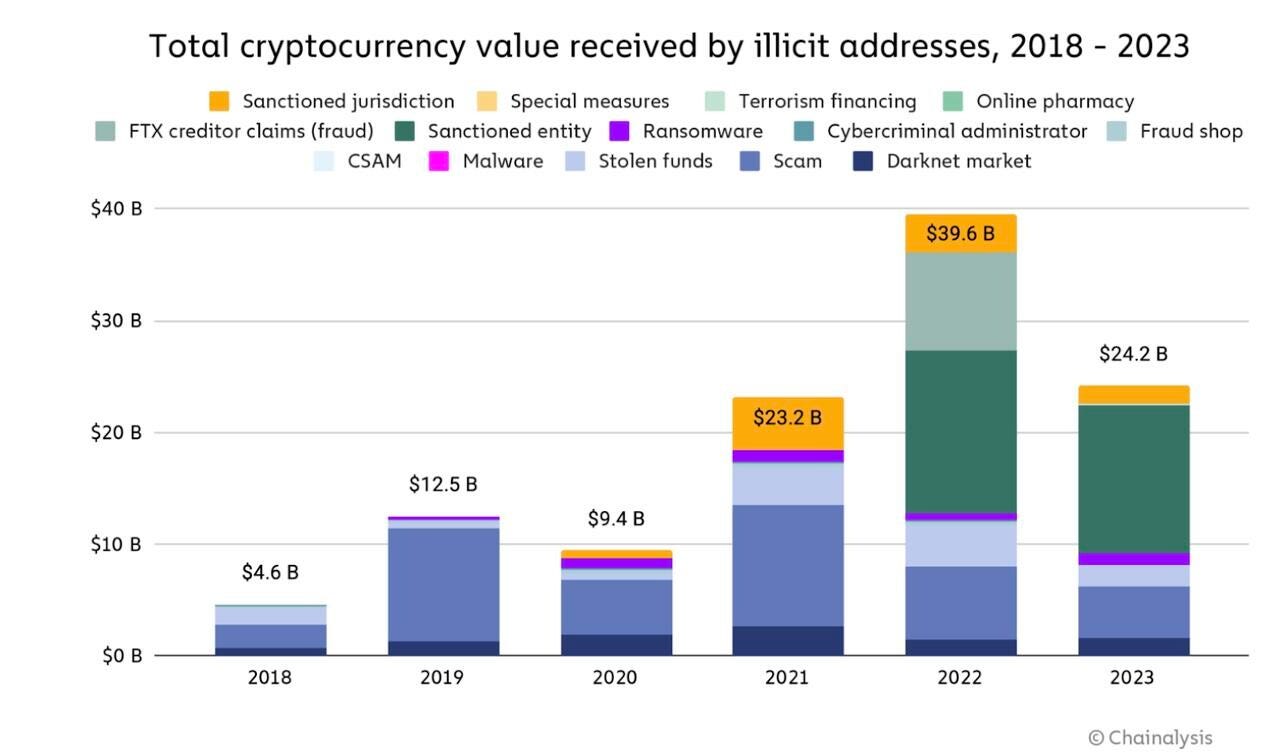
(Source: Chainanalysis)
Given the large potential for bad—and the proven chaos of the largest crypto companies like FTX, and Binance—, the market needed some additional assurances that crypto could be brought under control. There needed to be a crackdown before investors would dip their toes into the crypto waters.
Now, the SEC has gone as far as approving crypto-focused Exchange Traded Funds (ETFs)—basically, a shared portfolio of cryptos that a person can buy to mimic the performance of crypto as a whole instead of buying individual coins themselves (more on Forbes). This, in a way, is the fuel for the new rise in crypto optimism. The SEC went from crackdowns to regulation, allowing a gentle spring in the sector.
Yet, in a way, it seems like we are falling into the same trap as some years ago. Before the FTX and Binance fraud investigations, the hype around crypto was equally as strong. After all, when Bitcoin collapsed it was just about to reach a value of $69 thousand—its current record. The scenario begs the question if these new regulations are truly enough or if in years to come, crypto will collapse yet again. Is this an era of growth, or is the season's metaphor more accurate than we thought, with periods of spring being followed by harsh winters?
Perhaps it’s time to wrestle with a more complicated thought: we, as a society, are puzzled by crypto and don’t really know how to go about it. The SEC is trying to regulate it in part, but how can we regulate something we don’t truly understand?
What, precisely, is crypto anyway?
On the one hand, it is certainly a form of currency used worldwide. Some countries like Nigeria and Turkey have nearly 47% of the population actively owning cryptos (more on Statista). But if we think of crypto just as a coin, it is a rather unstable one. By some estimates, its volatility is 10 times higher than the US dollar—the most stable coin in the world—, and two times higher than the Turkish lira—one of the most volatile (more on Medium).
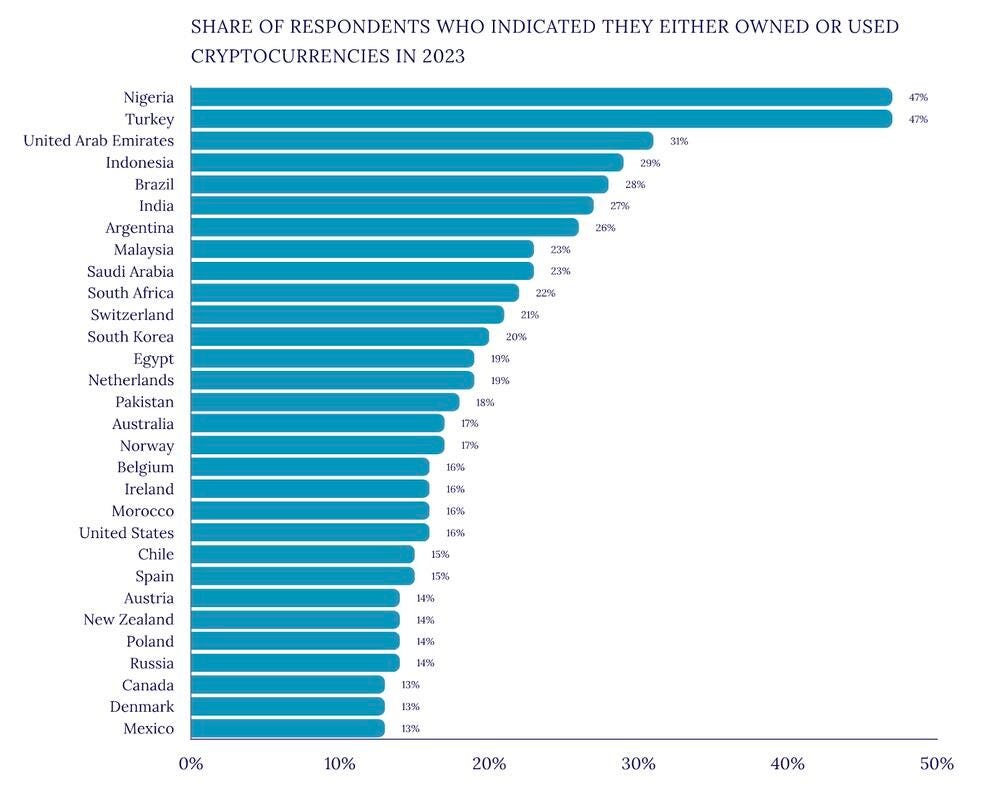
(Data from Statista)
We could, on the other hand, think of crypto as an asset more closely related to gold: easily convertible and growing in worth. Not many places take gold, but it's scarce availability and extended use across society do make it a priced commodity that can be safely transformed into currency. The same goes for crypto. There is a limited supply of Bitcoin and the ability to produce them decreases periodically as well—the so-called, “halving moments” which reduce Bitcoin production in half and often increase its value. If we think of it that way, Bitcoin has far surpassed gold as a safe investment even before its current uptick.
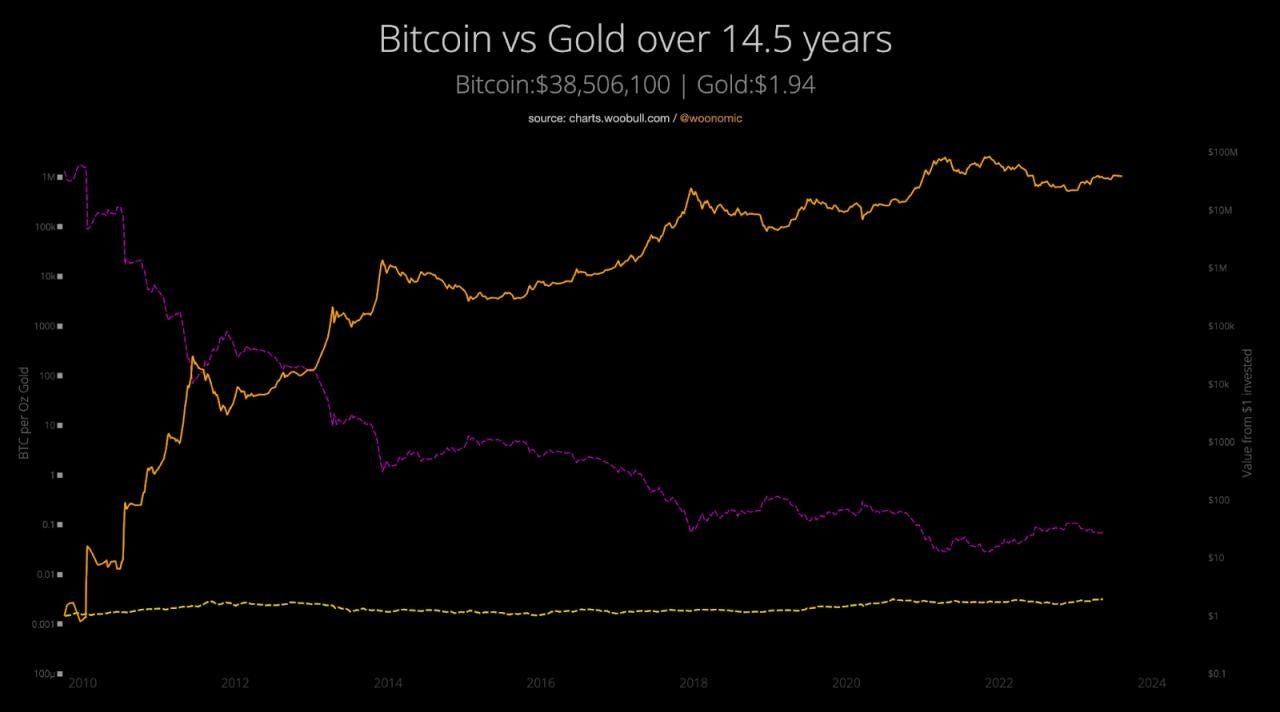
(Data from Woobull)
But Bitcoin is more complex than gold. When you buy gold, there is no inherent innovation in it nor a clear difference between providers except for the carats in the bar you just acquired. When you buy cryptos, on the other hand, you are making an implicit bet on technology, more specifically, on blockchain. If the future is built on blockchain as many enthusiasts hope, then we can also imagine that crypto prices will increase accordingly with such hype. Thus, we can think of cryptos being more similar to acquiring stocks in a large tech company whose mission you believe in.
And all of this without mentioning that cryptos are also a cultural phenomenon. They aren’t as established as a large tech company nor a piece of metal we trade for wealth. Their prices are subject to multiple political decisions from the SEC investigations to China banning bitcoin mining (more on The New York Times). But they can also be correlated to online hype or memes, like Elon Musk tweeting about doge coin (more on CNBC). As a society, we have gathered around cryptos in a way we don’t do with the US dollar or the Mexican peso. This adds another layer of volatility.
That, indeed, is the real problem with crypto. It is so volatile and unpredictable because we, as a whole, still don’t agree on what it is. The crackdowns from the SEC and the creation of crypto ETFs have brought more certainty to an uncontrolled field. But it remains far more convoluted than regular coins. Its value increases unlike any asset we’ve previously encountered, and it is often subject to broader forces than most stocks we commonly use.
So is this the end of a cold winter? Yes, that much is true.
Will another one follow? Who knows, there are still many unknowns to be solved.
Will there be lots of gossip in the coming years? You bet, and we at Nido are excited to cover it.