
Tech Tasting
Smarter Kitchens, Smarter Coffee, Smarter Dining?

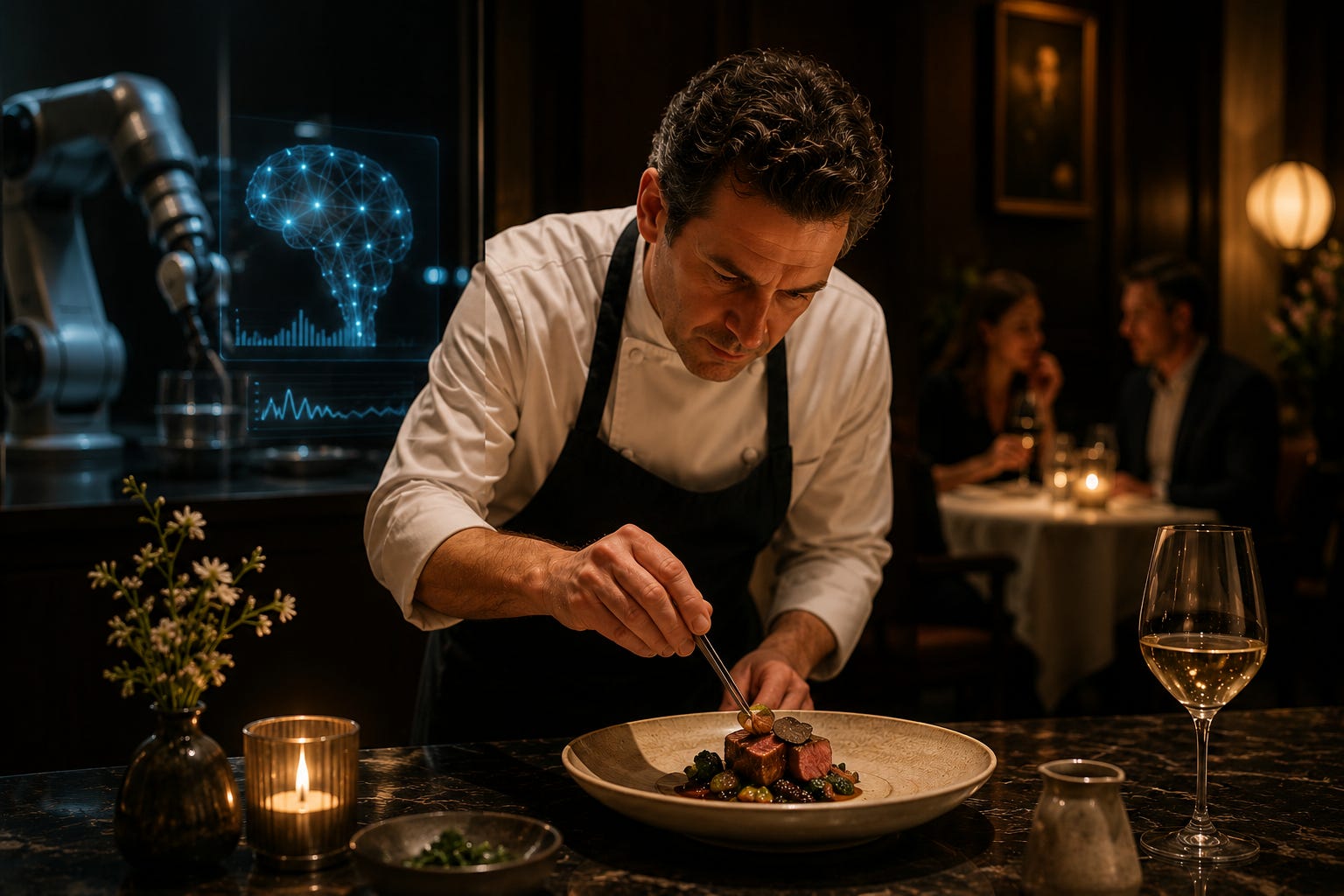
What is a restaurant, really?
The word ‘restaurant’’ comes from the French restaurer, meaning ‘to restore’, tracing back to a 1765 Parisian legendary tale where a soup vendor named Boulanger who hung a sign above his door quoting scripture: ‘Come to me all who suffer from pain of the stomach and I will restore you’ (more on Merriam Webster). His restorative broths gave the place its name, and what started as a concept rooted in physical nourishment has since expanded far beyond that.
Nobu. Le Bernardin. Le Jules Verne. CORE. Per Se. Alinea. These establishments are fine dining personified according to critics. They pride themselves on a unique culinary, human-driven experience. And yet the same forces now reshaping the corner burrito shop are rippling outward into coffee chains, fast food, ghost kitchens, and corporate cafeterias, touching almost every context in which food and drink change hands. Today, as digital ordering and AI reshape the industry, the most interesting question is whether the restaurant is once again changing what it means to ‘restore’ the customer. And perhaps more pressingly: Can it restore both body and soul when a robot is doing the cooking?
Brick-and-mortar is not dying. It’s hybridizing
The restaurant business remains brutally hard, with thin margins and high failure rates, but the smartest operators aren’t abandoning physical locations. They’re using technology to turn one address into a multi-channel revenue engine, with 70%+ of restaurants now offering mobile ordering and digital channels accounting for 20+% of revenue in fast-casual formats (more on Pratham). The physical restaurant is no longer just a place to eat. It has become a brand node, a fulfilment centre, and a data-collection machine, all wrapped in the smell of something good. Beyond the convenience story, the real narrative is unit economics: online ordering lifts average order value by 20 to 25%, AI-driven upselling and kiosks push it higher still, and restaurants deploying digital ordering and automation are reporting significantly lower labor costs alongside meaningful reductions in food waste through smarter inventory systems. These aren’t marginal gains. Compounded across thousands of locations, they’re the difference between a struggling chain and a structurally profitable one.
Where the new picks are: robots, beverages, and operations
The next wave of investment opportunity sits in the unsexy infrastructure layer. Companies like Pinto Robotics build countertop automation to streamline kitchen prep work for an industry where 30+% of restaurants weren’t profitable in 2023 (more on Pinto Robotics). Sidework’s intelligent beverage dispensers build complex drinks in under 10 seconds and can train an entire staff on the full menu in under 10 minutes (more on Sidework). The pattern mirrors what happened in e-commerce, where the companies that won weren’t always the customer-facing brands, but the picks-and-shovels providers that made the whole system run. Backing the infrastructure, in other words, has historically been the smarter bet.
The high-end exception: Why fine dining simply resists
Not every segment is racing toward automation. High-end restaurants are deliberately preserving high-touch service as a differentiator, treating the absence of kiosks and apps as a luxury signal in itself. A sommelier who remembers your palate, a maître d’ who recalls your last visit: these are features that no algorithm replicates convincingly, at least not yet. This creates a meaningful bifurcation. Technology is separating low- and mid-market operators who compound from those who fall behind, while the top of the market competes on exactly the opposite axis. In a way, the rise of automation has made genuine human hospitality more valuable, not less. The supply chain feels this too. Digital ordering and predictive demand tools are compressing inventory cycles, enabling restaurants and coffee shops to pre-position stock more precisely, reduce upstream waste, and create new B2B opportunities for vendors who can plug into this data layer. The restaurant of the future doesn’t just know what you’ll order. It already has the ingredients cut and ready, they’ll just wait for you to take a seat.
The battle for the future: Starbucks vs. Luckin Coffee
Perhaps no comparison better captures the tension at the heart of this culinary technological transformation than the story of Starbucks (more on Starbucks) and Luckin Coffee (more on Luckin). Luckin, now China’s dominant coffee chain, built its entire model on frictionless digital ordering, automation, and speed. No small talk, no barista banter, just an app, a pickup code, and your drink ready in minutes. On a personal note, when I visited one of its New York branches last summer I was told by a member of staff, promptly and without apology, “We do not take orders. We are a tech-enabled company. We are here to prepare drinks only.” My coffee arrived in under three minutes. An assembly line, inside a coffee shop. Efficient, absolutely. Memorable for the right reasons, less so.
Starbucks, by contrast, spent years chasing the same efficiency playbook and stumbled. Mobile ordering created bottlenecks, stores began to feel like fulfilment centres, and the brand’s original promise of a ‘third place’ somewhere between home and work quietly eroded. The new leadership has since pivoted back toward hospitality: slowing down, retraining staff, and reintroducing the idea that a coffee shop might also be somewhere worth lingering in. Whether that is nostalgia or strategy remains to be seen, but it is a meaningful signal about the limits of optimising purely for throughput and profitability.
Then there is Haidilao (more on Haidilao), the Chinese hotpot chain that arguably cracks the code entirely. Robots deliver ingredients tableside, tablets handle ordering, and the back-of-house runs with near-surgical precision. Yet the front-of-house is legendary for its warmth, offering free manicures while you wait, staff who remember your preferences, and a level of attentiveness that would embarrass most fine dining rooms. Haidilao proves that technology and hospitality are not opposites. They are complements, when the culture behind them is right. The question these three cases raise together is not whether to automate, but what you are automating for. Luckin automates for throughput. Starbucks is learning that throughput without warmth hollows out a brand. Haidilao automates for capacity, freeing its people to focus entirely on the human layer. That distinction, it turns out, makes all the difference.
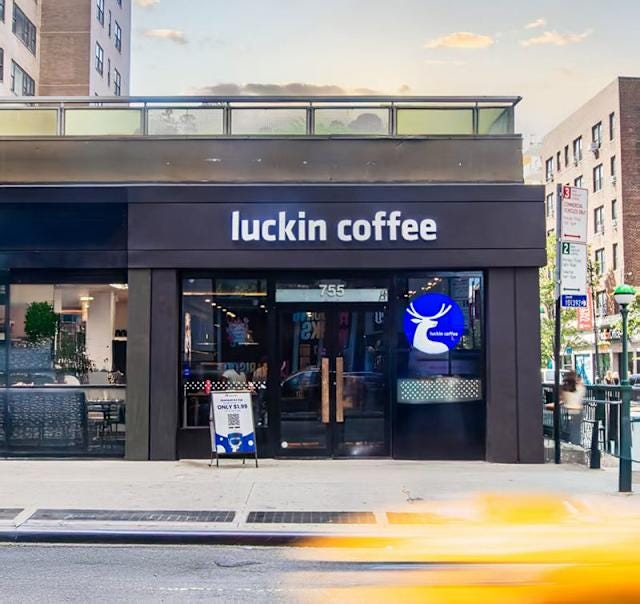
The luckin coffee branch in New York I visited (Source: Yahoo Finance)
The investor takeaway: who compounds, who gets left behind
Restaurants have become a live case study in what separates compounding businesses from stagnant ones. The winners will own demand through apps and data, scale one physical location into a digital brand, and optimise pricing and operations continuously. Operators still fully dependent on foot traffic and manual processes, on the other hand, face rising costs with no structural relief in sight. The floor is rising for everyone, but the ceiling is only rising for those who have invested in the infrastructure to reach it, with that graceful human touch.
Eating, drinking, fine dining: these are experiences that take place in spaces where important moments in the human story unfold. Birthdays, proposals, celebrations, grief, reunion. Many of the most formative experiences in a person’s life begin over a meal, in a room where someone has taken genuine care. One day, perhaps those moments will be low-touch, not human-driven at all. Or perhaps the technology, done right, simply clears the table so the people can get back to the point. Chatting, laughter, tears, joys, and everything in between.
We will have to find out, as we continue travelling and dining across the world.
If you are a chef, restaurant owner, or food critic, I would love to connect: nanaoduronyaning@gmail.com and nana.oduronyaning@nido.ventures
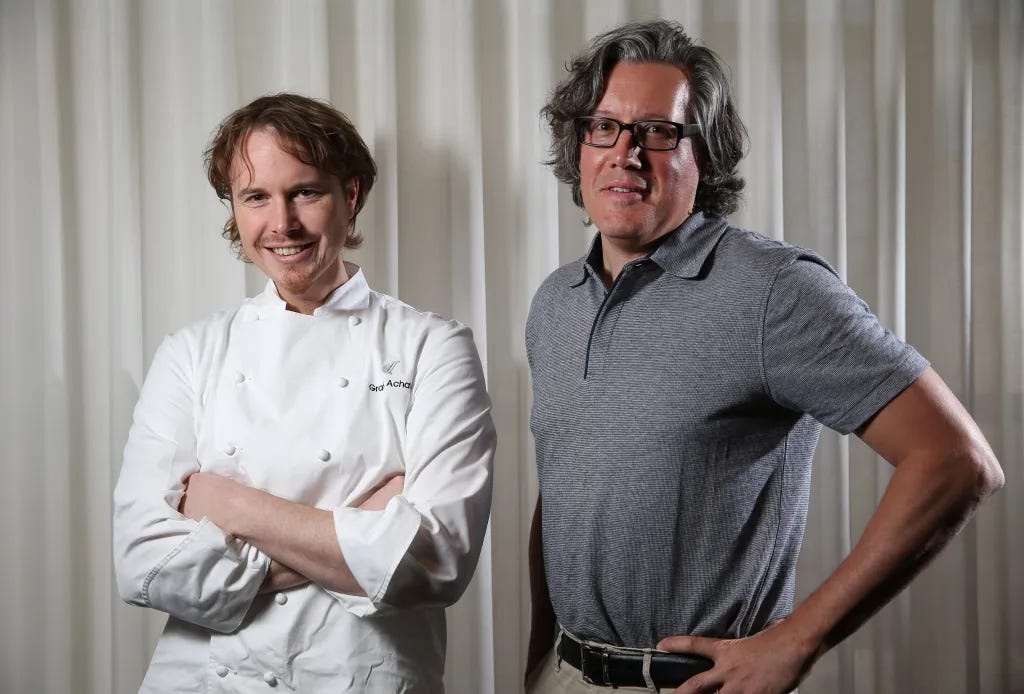
Grant Achatz and Nick Kokonas, co-founders of Alinea (Source: Chicago Tribune)