
Steel’s Balancing Act

As the global steel industry braces for a "winter" worse than 2008, Mexico emerges as a potential bright spot. This week, we're exploring how the country is positioning itself amidst industry turmoil.
Our analysis by Johan Petersmann reveals a complex landscape: from the bankruptcy of Altos Hornos de México (AHMSA) to new tariffs shielding domestic producers. Yet, we uncover promising trends: $5.7 billion in government investments, nearshoring opportunities with Tesla and GM, and Mexico's strategic advantage under USMCA. Could Mexico's steel sector turn global challenges into local triumphs?
As always, you're reading ConteNIDO, your go-to place for all things tech, AI, and Mexico/US. Make sure to subscribe to receive our up-to-date analysis 😉
Nido Indicators 🇲🇽🇺🇸
Auto Exports: 292.67 on Aug 01, 2024 (📈9.08% from Jul 01, 2024)
Consumer Confidence Indicator in Mexico: 47.60 on Aug 01, 2024 (📈1.06% from Jul 01, 2024)
Consumer Confidence Indicator in United States: 67.90 on Aug 01, 2024 (📈2.26% from Jul 01, 2024)
Federal Reserve Interest Rate: 5.50% on Aug 31, 2024 (🔒0.00% from Jul 31, 2024)
Bank of Mexico Interest Rate: 10.75% on Aug 08, 2024 (📉2.27% from Jun 27, 2024)
USD-MXN Exchange Rate: 20.07 on Sep 10, 2024 (📈6.59% from Aug 9, 2024)
S&P/BMV IPC: 51,136.05 points on Aug 26, 2024 ( 📈 52.61 points from Jul 26, 2024)
Inside Nido: What we are doing
This week we are welcoming a new member of the ConteNido team ! Welcome Johan Petersmann!

José Luis Sabau the pioneer of this project will continue onboard as ConteNido Editor!
We are looking for founding CTOs and CPOs to participate in our research, if interested please respond to our form.
Want to work for a Nido Portfolio Company?
Founding Engineer, Medellín
In the Know with Nido: What we are reading
🪖 Sheinbaum Appoints New Military Chiefs as Presidency Approaches
Mexican President-elect Claudia Sheinbaum has appointed General Ricardo Trevilla as defense minister and Admiral Raymundo Morales as Navy chief, emphasizing their extensive military backgrounds. This move reflects the military's growing involvement in national projects under the outgoing administration. Sheinbaum commended her predecessors and confirmed the importance of qualified leadership. (Reuters)
🛢️ Carlos Slim Boosts Talos Energy Stake After CEO Departure
Carlos Slim has increased his ownership in Talos Energy to 23.8% by acquiring 2.7 million shares after CEO Tim Duncan's sudden exit caused a stock decline. The billionaire investor is also expanding his investments in the oil and gas sector, including a stake in US refiner PBF Energy. (Bloomberg)
🇲🇽 Mexican Auto Industry Shows Strong Growth in August 2024
Mexico's auto production reached 352,615 units in August 2024, an 8.2% annual increase and the highest August output since 2018. Ford led growth with a 40.4% increase. Exports rose 1.6% to 292,670 units. The industry shows positive trends, surpassing post-pandemic recovery and potentially entering a new expansion phase. (El Financiero)
🚗 BMW's Hydrogen Revolution: Cars by 2028
BMW is set to introduce hydrogen-powered vehicles by 2028, partnering with Toyota to innovate fuel-cell technology. Despite challenges like high costs and limited infrastructure, the automaker sees hydrogen as a viable complement to electric vehicles, especially in areas with scarce charging options. Collaborative efforts aim to reduce production expenses. (Bloomberg)
📈 Mexico Introduces New Regulations to Empower Small Business Listings
Mexico's securities regulator has greenlit new rules aimed at enhancing debt and equity listings for small and medium-sized enterprises (SMEs), potentially unlocking 70 billion pesos ($1.4 billion) annually. These reforms seek to simplify the listing process and boost financial inclusion, while also reviving the country's capital markets. (Bloomberg)
🚀 Anthropic Unveils Claude Enterprise: A New Contender Against ChatGPT
Anthropic has launched Claude Enterprise, a subscription plan tailored for businesses seeking enhanced security and administrative features. With capabilities such as large context windows, GitHub integration, and specialized workspaces, this new offering aims to compete directly with OpenAI's ChatGPT Enterprise, providing greater customization for enterprise demands. (Techcrunch)
🛍️ Nordstrom Family and Mexican Retail Group Join Forces in $3.76 Billion Bid
The Nordstrom family, holding a 33.4% stake, proposes to take the retailer private in partnership with El Puerto de Liverpool. The $3.76 billion offer comes amid mixed sales performance, with a special board committee set to review the bid following Bruce Nordstrom's passing. (APS News)
🌍 Mexico: A Rising Data Center Powerhouse Mexico is positioning itself as a strategic hub for data centers, driven by its proximity to the U.S. and digital economy growth. By 2027, energy demand may soar to 1500 MW. Hitachi Energy is facilitating this expansion through renewable energy, digital innovation, and green hydrogen technologies to achieve sustainability goals.(Energia Estrategica)
In-depth with Nido: What we are thinking
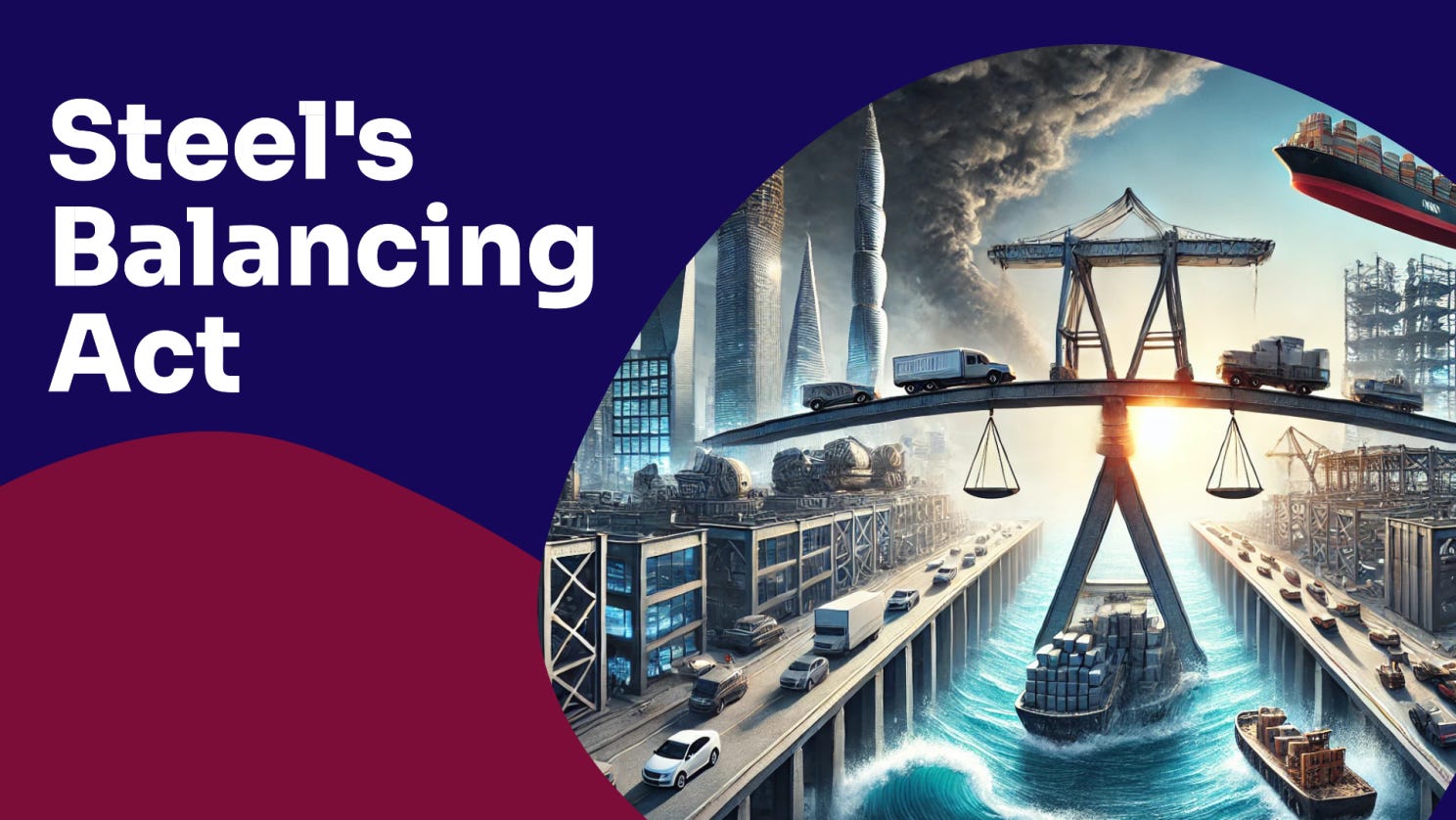
If the global economy is a finely tuned machine, then steel is its fuel, holding together the infrastructure that keeps it running. No, really. You might not think much of it, but steel is everywhere—from towering skyscrapers to cars on the streets.
However, the industry today is facing significant challenges, driven by global competition, trade policies, and environmental shifts. Most recently, a warning from China Baowu Steel Group Corp—the world’s largest steel producer (more on Bloomberg)—has emerged as the Chinese property crisis kills domestic demand and propels a wave of steel exports. So, this week, we wanted to take a closer look at steel and why it matters. Moreso with the bankruptcy of Altos Hornos de México (AHMSA) and the failed acquisition of U.S. Steel by Nippon Steel highlighting the difficulties facing the industry globally.
Let's start with the basics.
The steel industry has always been critical to industrial strength. In 2023, the World Steel Association reported global steel production of 1.88 billion tons, with China outputting more than half (more on S&P Global). However, due to demand shifts stemming from the property crisis in China, the post-COVID interest rate environment, and protectionist trends, the number may soon be decreasing.
A recent warning from China Baowu Steel Group, which produces about 7% of the world’s steel, predicts a “winter” worse than the 2008 and 2015 downturns (more on Bloomberg). This is primarily driven by China’s prolonged property market slump. As we can observe in the chart below, steel margins are under pressure in China, prompting companies to sell in foreign markets.
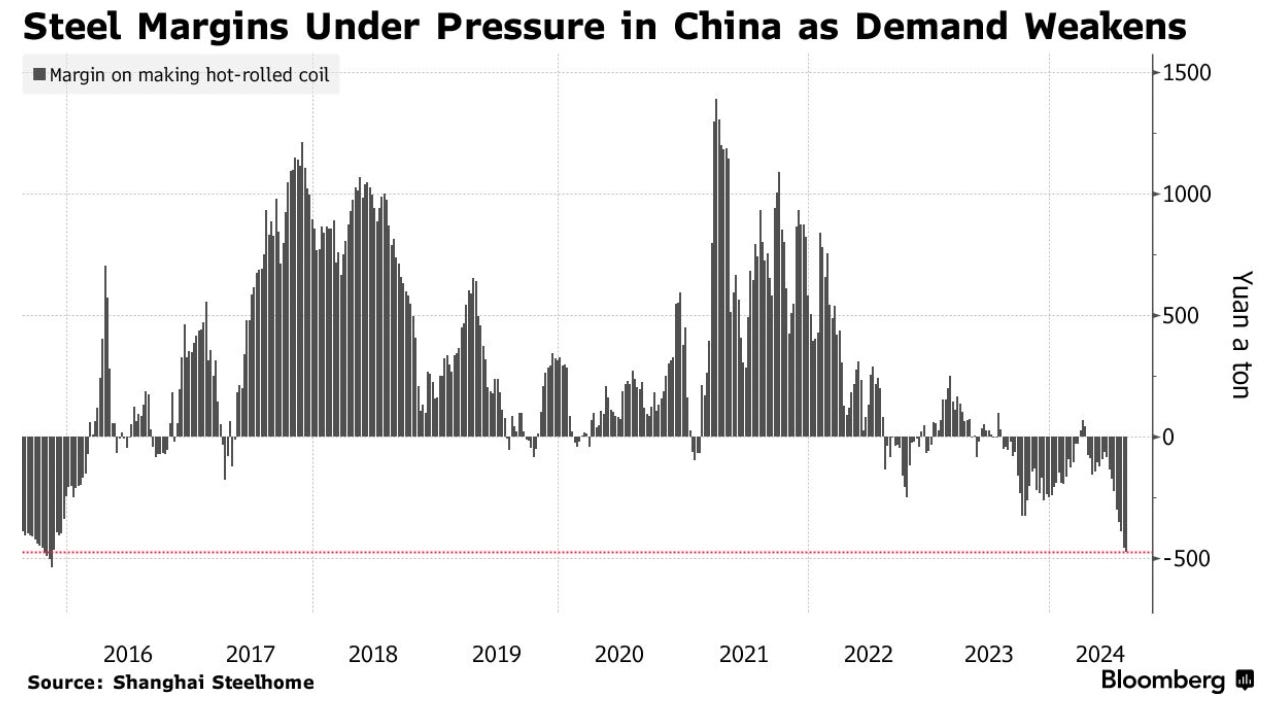
China is expected to export 100 million tons of steel in 2024, the most since 2016, driving down global prices and squeezing foreign producers.
On that note, while AHMSA’s collapse in August 2024 was largely credited to fraud and mismanagement (more on Milenio), cracks began to show when low steel prices in the late 1990s led to one of the largest and most complicated debt restructurings in Mexico’s history (more on Willkie Farr and Gallagher LLP), showcasing the serious consequences a downturn in steel, like the one predicted by Baowu, might have on the industry today.
But recent tariffs might help prevent a grim picture for Mexico. Where previously Mexican producers would have had to compete with cheap Chinese steel imports, both domestically and in the U.S., new U.S. tariffs on Chinese steel and greater scrutiny of Chinese imports into Mexico (more on NYT) will soften competition. This is especially relevant as the Chinese property crisis is incentivizing steel exports and squeezing international markets; in other words, Mexico is dodging a big bullet while the rest of the world absorbs more of the load.
The collapse of the Nippon Steel-U.S. Steel merger further illustrates the complexity of the global steel market. The proposed $14.9 billion acquisition would have created one of the world’s largest steel producers. However, concerns over national security and the potential loss of American jobs led U.S. lawmakers and unions to oppose the deal (more on Reuters).
The failed takeover highlights that low prices and tariffs are only more straws being mounted on the back of an industry already scrutinized by regulators and labor unions.
One of the most significant external pressures on the steel industry is the broader global economic downturn. As central banks around the world raised interest rates in the wake of post-COVID inflation, industries relying on steel, like construction and manufacturing, have slowed down, which has ultimately been contributing to the slump in demand for steel.
It’s not all bad news, however. In the U.S., the construction industry is expected to see an uptick this year, with single-family home starts estimated to increase 4.7%, according to the National Association of Home Builders (more on Mordor), as a result of housing-shortage-induced demand. Moreover, infrastructure projects, such as the Jobs Act and CHIPS Act in the U.S., are expected to provide stabilizing tailwinds (more on Steel Market Update). Similarly, emerging markets like India are expected to see increased demand as infrastructure projects continue to grow (more on FSS).
And in the long run, Mexico’s steel industry remains well-positioned to benefit from nearshoring opportunities. With many companies looking to diversify their supply chains away from Asia, Mexico’s strategic location, low labor costs, and favorable trade agreements like the USMCA make it an attractive destination for automotive and electronics manufacturing (more on Forbes). Recent announcements from companies like Tesla and GM regarding new production facilities in Mexico underscore the potential for growth, particularly in sectors such as electric vehicles (EVs) (more on Reuters). Not only that, but the Mexican government has also pledged fresh investments into the industry totaling US$5.7 billion, which will help close the gap left by AHMSA (more on bnamericas).
For investors, these nearshoring trends and government support represent a unique opportunity to invest in Mexico’s growing role in North American supply chains, particularly as companies look to relocate or expand operations to mitigate global disruptions.
The global steel industry is facing one of its most challenging periods, caught between low global prices and high tariffs as part of a greater protectionist trend. Despite the global downturn and challenges, however, in the longer term, countries like Mexico, which are benefiting from nearshoring, are well-positioned to benefit from an upturn in steel.
Written by Johan Petersmann