
Juarez is Mexico’s Future

🏭 Ciudad Juárez might hold the future of Mexico. Yes, really.
Although you might only think of Juarez as a border town, it is actually a complex industrial economy that exports millions of dollars worth of goods to the US every year.
We even found that its economy is more complex than Portugal and Spain, and its sheer GDP is closer to that of other countries than that of other cities.
In a way, the same myths about Juarez are those that many have about the Mexican economy. Namely, that the country focuses on commodities and has little technical skills. The truth is very far from this. Mexico is a complex economy mostly focused on electrical engineering and car assembly.
These forces are what now make Mexico and building grounds as Juarez, the crucial foundations to nearshoring. It’s not just that Mexico is close to the US, but that it also holds immense manufacturing potential.
So sit back and let us tell you how Juarez is a microcosm for the entire country.
As always, you are reading ConteNIDO, your one-stop shop for all things tech, VC, and Latam. And, of course, your ticket inside Nido Ventures ;)
Don’t forget to subscribe to receive our content directly to your inbox every week.
Inside Nido: What we are doing
Last week our Co-Founding Partner Ana Carolina Mexia Ponce and Maria Gutierrez Penaloza had a working session in Mexico. They celebrated Renata Solana Carvajal's second anniversary at Nido Ventures!
In the Know with Nido: What We Are Reading
💼 It’s been quite the week for layoffs. To start, the tech industry continues to experience significant layoffs in 2024, following large-scale job cuts in 2022 and 2023. So far, 60,000 jobs have been cut across 254 companies, including major firms like Tesla, Amazon, Google, TikTok, Snap, and Microsoft. Similarly, Lucid Motors is laying off around 1,300 employees, about 18% of its workforce, as part of a restructuring plan aimed at cutting costs following significant financial losses in 2022. (Techcrunch)
🤝 The Communications Workers of America—a major labor union—is negotiating a labor agreement with Micron Technology for its $50 billion investment in New York, backed by the 2022 Chips and Science Act. This effort could create 9,000 jobs and influence other semiconductor companies to follow suit, while also creating new relationships between tech and unionized labor. (Bloomberg)
⚖️ In a long-awaited decision, the U.S. Department of Justice filed an antitrust lawsuit against Ticketmaster and Live Nation, accusing them of using monopolistic practices to dominate the event industry. Many are seeing this as the testing ground for more anti-trust regulations that could potentially hit big tech in later years. (Wired)
🖥️ South Korea will not stay behind when it comes to semiconductors. South Korean Hanmi Semiconductor has seen a 1,200% surge in its share price since the end of 2022. However, this is now prompting investors to cash out amid high valuations. Foreign ownership has declined from 16.5% in mid-February to 13.2%.(Bloomberg)
💻 What? More OpenAI News? Who would’ve thought? The AI giant has upgraded ChatGPT with impressive document analysis capabilities, enabling the chatbot to review, alter, and generate graphs from files on Google Drive, Workspace, and Microsoft OneDrive. This new functionality allows users to add files directly from these drives. (Wired)
🏦 E-commerce and fintech leader, MercadoLibre, has begun talks with Mexican authorities for a banking license, aiming to capitalize on the growing demand for financial services. Mexico, with less than half of its population banked, provides a fertile ground for fintech startups, as several fintech firms seek banking licenses to offer a comprehensive range of services from Brazil’s NiBank to the UK’s Revolut. (Bloomberg)
💸 H, a French AI startup, formerly known as Holistic AI, raised an unprecedented $220 million seed round in record time. The company, led by Charles Kantor and a team of ex-DeepMind professionals, is focused on creating AI agents to enhance worker productivity. (Techcrunch)
💥 The VC landscape for emerging fund managers is becoming more competitive, with a larger number of funds competing for a smaller portion of available capital. PitchBook is now tracking over 10,000 funds currently trying to raise money, and 45% of them are emerging fund managers, defined as a firm with less than three funds. (Techcrunch)
In-depth with Nido: What we are thinking

Odds are, you’ve never thought much about Ciudad Juárez. We can’t blame you—the world seems to be rooting against it. If and when the city appears on the news, it is often concerning El Paso—its close US neighbor—, marked as nothing but a “border town” across one of the largest land borders in the world. Not surprisingly, the topics covered when speaking of Juarez—as the locals call the city—tend to be those of illegal immigration or some form of violence. And, to some degree, that much is true; immigration and crime have been a part of recent history in Juarez—just as they have been in Mexico as a whole. But there is also more to the city than a handful of headlines.
We want to be bold: Juarez might well be the laboratory for Mexico’s future. Let us explain.
In many ways, Ciudad Juarez is the perfect city to study the recent phenomenon of nearshoring. Namely, the rising interest from the US and Western countries to decouple from China and find new countries to relocate their supply chains (more in Bloomberg). Mexico has emerged as the key alternative to China in recent months—even surpassing China as the top trade partner to the US (more in Business Insider).
For those outside of Latam, a question naturally arises when presented with this scenario: Mexico, really?
And, again, the thought isn’t radical when most headlines about Mexico focus on politics or cartels. Yet, by looking at Juarez, we can get a clear sense as to why Mexico is now in everyone's mouth—and why Juarez should be as well. That is all the things that make Mexico an attractive destination despite many misconceptions.
So let’s start with some serious myth-busting—that’s how to truly understand Mexico’s moment (more on Forbes Mexico).
You see, Juarez isn’t just “a border town”—it is a big city. It's a really big city, in fact. In the last census, it was estimated that over 1.5 million people lived in Ciudad Juarez, making it larger than all but six cities in the US—and, coincidentally, the sixth largest in Mexico (more on INEGI).
But Juarez is not just a big city: it is an economic colossus for Mexico. As of 2022, it was estimated that Juarez had a GDP of $26.9 bn—roughly the same as the GDP of entire countries like Zimbabwe or Georgia (more in El Heraldo de Juarez and the World Bank). That is equivalent to 1.6% of Mexico’s entire GDP and 43.5% of the GDP of the state of Chihuahua, where Juarez is located.
This economic power is precisely the thing most people get wrong about Juarez. By virtue of its location in close proximity to the US, the city has become an intuitive point for commerce and a crucial player in the US-Mexico relationship. In 2023 alone, Juarez exported a total of $105 bn worth of goods of which 97% headed to the US (more on Mexico’s Secretary of Economics). This phenomenon has grown dramatically in recent years, growing by 142% since 2006.
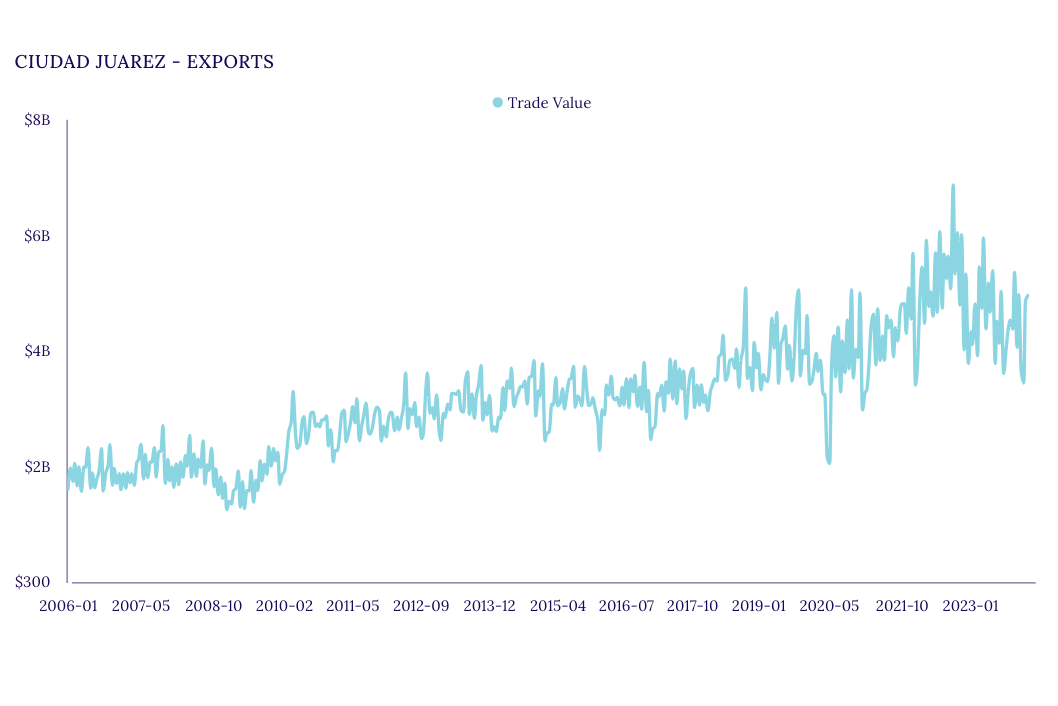
But what makes Juarez special is not that it serves as an entry to the US market but rather that it is the starting point for such trade. More than a border crossing point, the city has transformed itself into a manufacturing ground for a large variety of goods that have the US as their end destination. This, of course, wasn’t always the case. In the 1960s, Mexico’s government sought to create manufacturing opportunities along the border in hopes of increasing the nation’s industrial backbone while allowing US companies to use Mexican labor.
The result was maquiladoras: large factories (mostly in the textile realm) designed to assemble goods for the country’s close neighbor (more on Co-Production International).
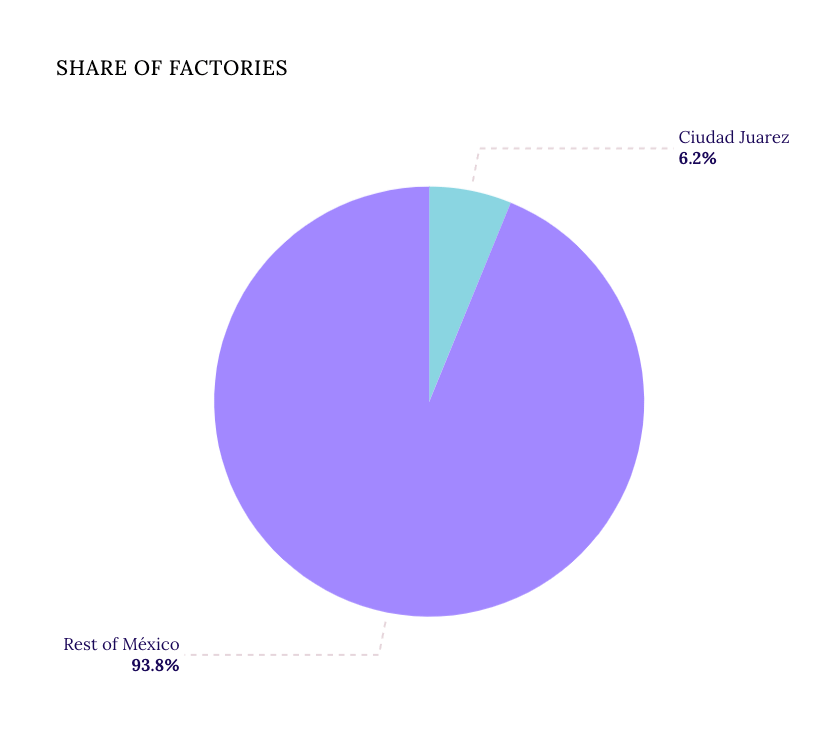
Juarez was one of the early grounds for the Maquiladora system, attracting large investments from across Mexico and the world. To this day, the investment shows. If Juarez was once a small border crossing, it now holds some 6.2% of Mexico’s factories (more on Juarez Municipal Planning and Research Institute).
Crucially, maquiladoras were just the first step in the Juarez industrialization—much like Mexico has evolved away from the early stages of manufacturing into more complex products. Today, Juarez produces a whole range of complex products from cars to computers (more on Mexico’s Secretary of Economics). That, precisely, is the point. The city has decades of experience in the manufacturing industry and, quite naturally, has evolved from early assembly lines to increasingly complicated products.
So it's not just about how much Juarez builds, but what it builds instead. So, at Nido, we decided to go one step further and determine the economic complexity of the city’s exports.
To do this, we gathered two data points. First, we obtained a data set on all the exports the city sent to the rest of the world in 2023 (see the data at Mexico’s Secretary of Economics). Then, we turned to Harvard’s Growth Lab to accurately depict the complexity of these products (see their categorization in their Atlas of Economic Complexity). For years, the lab has been categorizing the complexity of basically every product you can imagine on a scale that goes roughly from -4 (least complex) to +4 (most complex) and giving every country a score—although it’s not a perfect scale. For context, the most complex goods of the last ranking were photographic plates and film, with a score of 2.3, while the least complex goods were tin ores and concentrates, with a score of -3.37. This means that the amount of components and knowledge needed to make photographic plates and film is significantly higher than that needed to extract tin ore from the earth.
Taking these metrics, we were then able to score every product Juarez exported in terms of complexity as of the year 2023. By doing so we found that an overwhelming amount of the manufacturing power in Juarez focused on complex goods (those with scores above 0) instead of the least complicated goods considered by the Growth Lab’s classification (those with scores below 0).
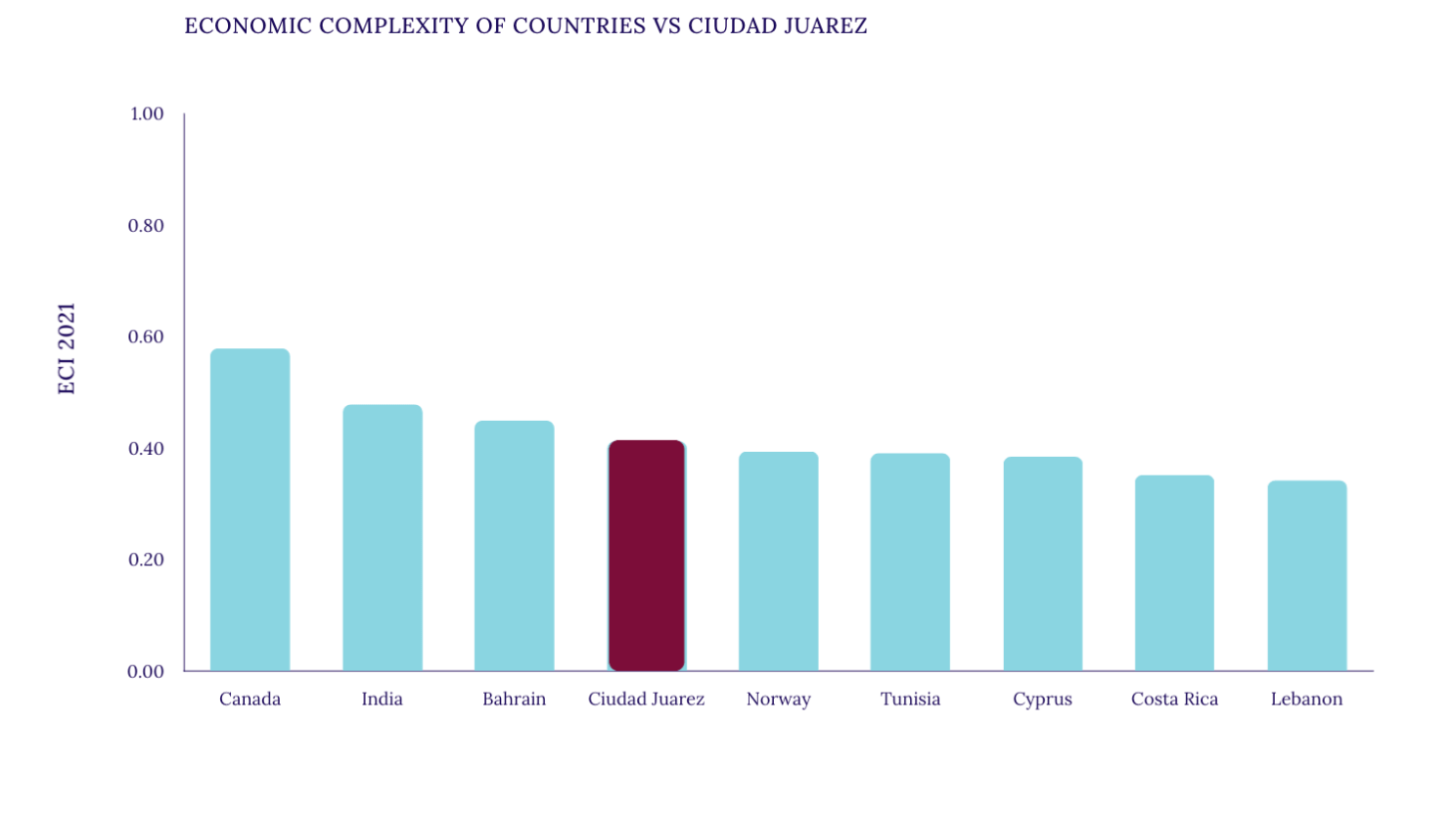
With this data in mind, we were then able to find the overall complexity of the Juarez economy. That is, we found the average complexity of goods Juarez shipped weighted by the proportion of trade they represented. The resulting score of 0.88 is comparable to those of the Netherlands (0.99), and Estonia (0.99) while surpassing those of developed countries like Spain (0.75) and Portugal (0.74). The same happens with Mexico as a country. Despite common conceptions of the Mexican economy as a commodities-focused market, it is actually the 22nd most complex in the world with a score of 1.13 according to the Growth Lab’s data (more on their website).
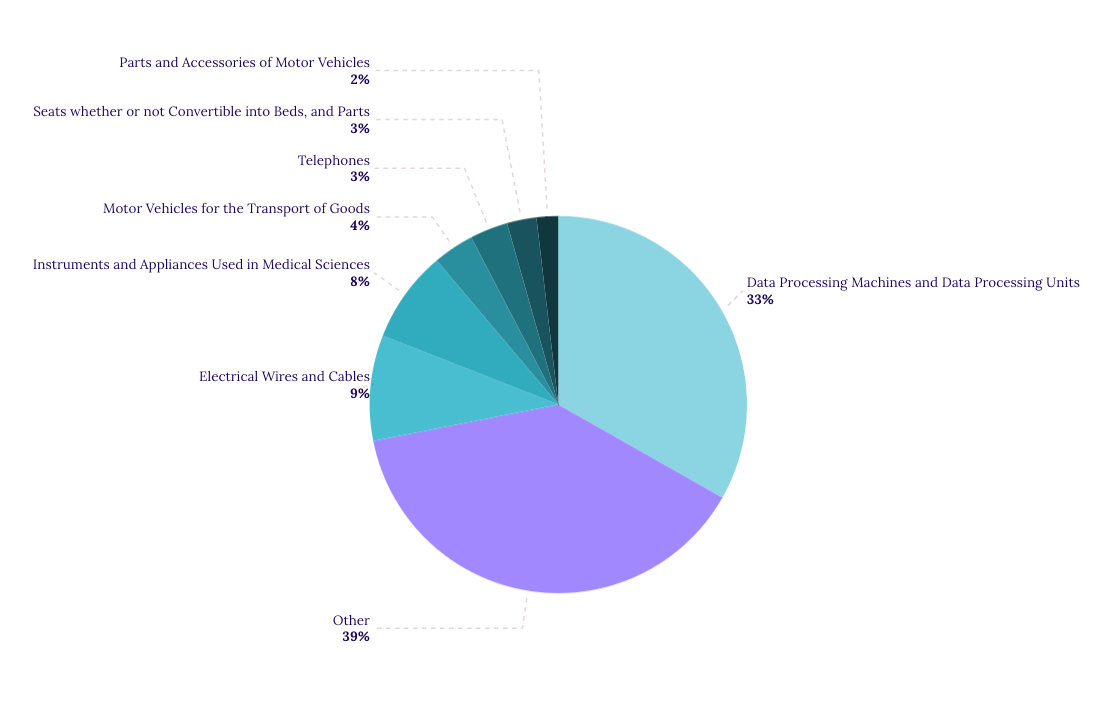
This, really, should come as no surprise when you look at the main products Juarez exports to the world—and, again, mostly to the US. The largest exports from Juarez by economic value are actually data processing machines (32.7% of all exports) followed by electrical wires (8.9%) and medical instruments (7.8%).
Thus we reach a realization. Despite common media portrayals, Juarez is an economic powerhouse from which the US gets an already large amount of its complex imports. If one Is to replace China as a supplier, then it is crucial to look at cities like Juarez and countries like Mexico where there is already a large industrial capacity waiting to be exploited. At Nido, we are convinced these are the forces that will reshape Mexico—and Latam—in the coming years. And so, when thinking of Juarez, we can’t help but bust a myth or two.