
Everything is Entertainment
The rise of the attention economy in a world of disengagement

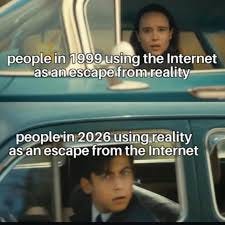
The Super Bowl had millions of people glued to their screens a few weeks ago. As Americans (and other football fans around the world) do every year, jersey-clad families united and avocados were mashed in preparation for the festivities. As many eyes were glued to the (frankly underwhelming) match itself as to the ads—which reveal a little bit about culture, society, and paint a large picture of where we’re at.
A particular ad caught many of our fleeting attention spans—and drew angry responses from a clearly offended Sam Altman. I’m talking about the Anthropic ad for Claude, which poked fun at ChatGPT’s decision to start introducing ads into their AI chatbot. The short 30-second video painted a surreal and slightly absurd picture: users being interrupted mid-sentence with offers for specific products and tailored discount codes. It ended with a bold assertion: Ads are coming to AI. But not to Claude.
More than the video itself, I’m interested in that last claim—why are ads coming to AI in the first place or at all? More broadly speaking, why do ads seem to be everywhere we look?
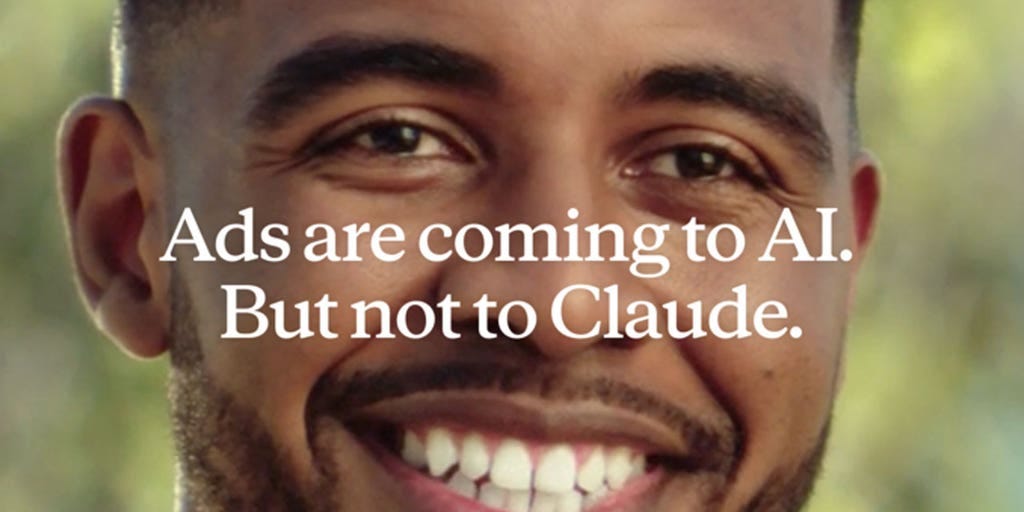
The pivot towards showing ads in ChatGPT is a symptom of a broader, more deeply structural shift for profit from within OpenAI, argues Kayla Scanlon. The real money, she says, turns out to be in capturing attention. AI is incredibly costly to build and run, yet it’s still trying to find enough paying customers. Training cutting-edge models can cost billions, but only a small percentage of users actually subscribe. Some firms are already pulling back. When an AI company pivots toward building a social media platform, it signals a search for scale. They’re after users, engagement, data, and advertising revenue to help cover the immense costs of growth. In many ways, social media becomes the fallback monetization strategy: if software licenses, subscriptions, or enterprise deals don’t generate sufficient returns, companies turn to attention. It’s predictable—people keep scrolling, and advertisers keep spending.
In an attention economy like ours, the biggest currency is time spent on a particular video, article, photo, etcetera etcetera. An abundance of information creates a poverty of attention, and user engagement becomes a valuable currency.
The world around us is designed to keep us disengaged, and whoever holds that engagement the longest, wins.
We’ve reached a point where everything must perform to survive—news, identity, politics (look at Trump, ICE, and the spectacle of it all), art, even relationships. As information becomes infinite, meaning is flattened into whatever can capture and hold attention the longest, regardless of truth or value. Platforms no longer just distribute content; they shape behavior, incentives, and culture by rewarding spectacle over substance. When attention becomes the primary currency, systems optimize not for human flourishing, but for engagement at all costs.
The Attention Economy’s Origins
“The attention economy is devouring Gen Z” reads a provocative op-ed by Scanlon in the New York Times. She argues that the rise of the attention economy has turned our eyeballs into commodities. Companies have shown time and time again that they are willing to pay big money to have our eyes glued to their products and digesting their advertisements—a movement that has fundamentally altered the way our generation functions.
Originally coined in the 1970s by professor Herbert A. Simon, the term Attention Economy has resurfaced in recent years with good reason—it aptly theorizes our current digital landscape better than many other attempts I’ve read. Simon warned that “a wealth of information creates a poverty of attention,” predicting that as information became abundant, human attention would become the scarce resource. Today, that scarcity is precisely what is being bought, sold, and optimized at scale.
In the decades since Simon’s insight, the internet has transformed from a tool for accessing information into an ecosystem designed to capture and monetize engagement. Platforms measure success not by how well they inform, but by how long they retain us. For Gen Z—digital natives who have grown up alongside smartphones and social media—the consequences are particularly acute. Our social lives, education, entertainment, and even activism are mediated through platforms whose primary incentive is to keep us watching.
Which brings us back to the question of AI: What’s it even doing here in the first place?
Chatbots and Advertisement: the Ultimate Search for Profit
Social media features like infinite scrolling, autoplay loops, notifications and emotional triggers are all engineered to keep us hooked. And it’s worked: the American Psychology Association estimates that the average American teen spends 4.8 hours on social media a day. The result? Social media companies are cashing in the big bucks. Facebook makes 97.5% of its revenue from advertising alone, with an estimated quantity of over $123.73 billion dollars in 2026.
This model is clearly profitable. At a crucial moment of development and inflection, OpenAI has demonstrated its first shift towards structuring itself to fit the attention economy. The logic is simple. AI models are expensive to train, maintain, and scale. If subscriptions alone cannot cover those costs, advertising becomes the most reliable fallback. The infrastructure of persuasion—targeting, data collection, engagement metrics—is already well established by social media giants. Plugging AI into that system would not be a radical departure; it would be the next step in a long evolution of monetized attention.
Which makes Claude’s staunch assertion of its values even more compelling. In a world where everything is entertainment and everything must perform, AI stands at a crossroads: will it become another arena for commodified attention, or can it resist the gravitational pull of the attention economy?
Everything is Entertainment: What Remains in the Attention Economy?
The picture this all paints is, frankly, a little bleak. In an attention economy, the only things that last and survive are those which serve an entertainment purpose: everything is reduced to spectacle in order to survive. Things which shouldn’t necessarily be considered “entertainment” suddenly are (take a look at politics, for one), and entertainment made for entertainment purposes is slowly flattened of meaning—it doesn’t need to be good, critical, deep, or substantial, it simply needs to hold our attention the longest.
The deep societal and psychological implications this shift holds notwithstanding, what’s most striking is how total the transformation has been. Entertainment is no longer a category of content—it’s the logic structuring everything around us. Politics becomes spectacle, technology becomes performance, even productivity must brand itself to survive. In an economy where attention is scarce and endlessly competed for, the question is less about whether ads will enter AI or whether everything feels theatrical—it’s about recognizing that this is the system we now inhabit. The attention economy doesn’t just shape what we watch; it shapes what gets to exist at all.
And so the debate over ads in AI is not really about a single product decision or a single company’s values. It’s about whether a new layer of digital infrastructure will inherit the same economic DNA as the platforms that came before it.
If AI becomes ad-supported, it won’t simply display banners. It will learn to optimize conversations for engagement. It will nudge, personalize, suggest, and subtly steer—because that is what advertising systems are built to do. The danger is not the occasional discount code interrupting your train of thought; it’s the gradual reshaping of thought itself around what performs best. When revenue depends on time spent and clicks generated, neutrality becomes expensive. Depth becomes inefficient. Frictionless persuasion becomes the norm.
The more unsettling possibility is that AI could become the most powerful attention-capturing device yet invented. Unlike social media feeds, which compete for your glance, AI competes for your cognition. It doesn’t just show you content; it converses with you. It adapts to your tone. It learns your preferences. In an ad-driven model, that intimacy could be monetized with unprecedented precision.