
Alpha Chasers
How hedge funds became intelligence machines



“This is a business that requires a willingness to take risks and to generate returns. You can’t do that unless you have a healthy appetite for risk” - Dan Loeb, Founder and CEO of Third Point, LLC
Alpha in finance represents the active return on an investment compared to a market benchmark such as the S&P 500. It is widely used to evaluate mutual funds, hedge funds, and actively managed portfolios. A consistently positive alpha suggests a fund manager is adding value beyond market returns, negative alpha could result in closing down your fund for good if not quickly reversed.
In order to generate alpha consistently, you need edge.
Hedge funds have always chased edges. Initially in information, then in analysis, and now in technology. Today the leaders resemble tech companies more than financial institutions, and the next frontier is artificial intelligence.
What are Hedge Funds
Hedge funds (HFs) are private investment vehicles that pool funds from multiple investors to generate absolute returns, regardless of market conditions. They are typically structured as limited partnerships (LPs), with the fund manager acting as a general partner (GP) and institutional investors as limited partners (LPs). Examples of hedge fund LPs include pension funds, endowments, insurance companies, sovereign wealth funds, and family offices. This LP structure allows the GP to maintain control over investment decisions (more on Investopedia).
HFs chase alpha through a variety of investment strategies, including the use of leverage, short selling, and other non-traditional investment methods. They often have lock-up periods and higher fees (2% management fee and 20% performance fee typically), making them suitable for sophisticated investors and institutions.
As a result of this structure, elite fund management, talent, and technology, hedge funds reward both GPs and LPs handsomely within mere months at scale.
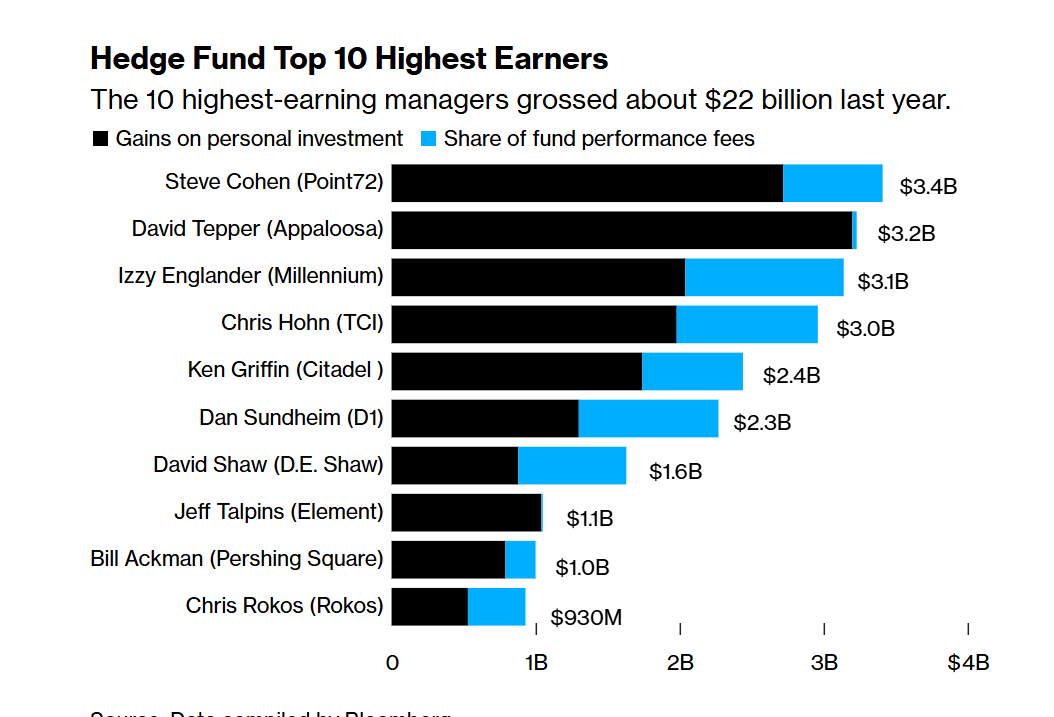
Why Hedge Funds Exist
Markets are not perfectly efficient. Inefficiencies arise from human behavior, structural constraints, and gaps in information. Institutional investors—from pension funds to endowments—rely on hedge funds to generate returns that passive strategies cannot. Hedge funds provide liquidity, improve price discovery, and absorb risk. They do so through a variety of strategies: Global Macro, Directional, Event-Driven, Relative Value, Long/Short Equity, Market Neutral, Merger Arbitrage, Credit, Short Only, Quantitative, and more. Key examples include Bridgewater Associates mastering macro investing (more on Bridgewater Associates) and Renaissance Technologies using quantitative strategies (more on Renaissance Technologies). With the advent of AI, the possibilities are endless.
Hedge funds exist because extracting insight from complexity requires singular focus and sophisticated tools. Large institutions ultimately seek diversification.
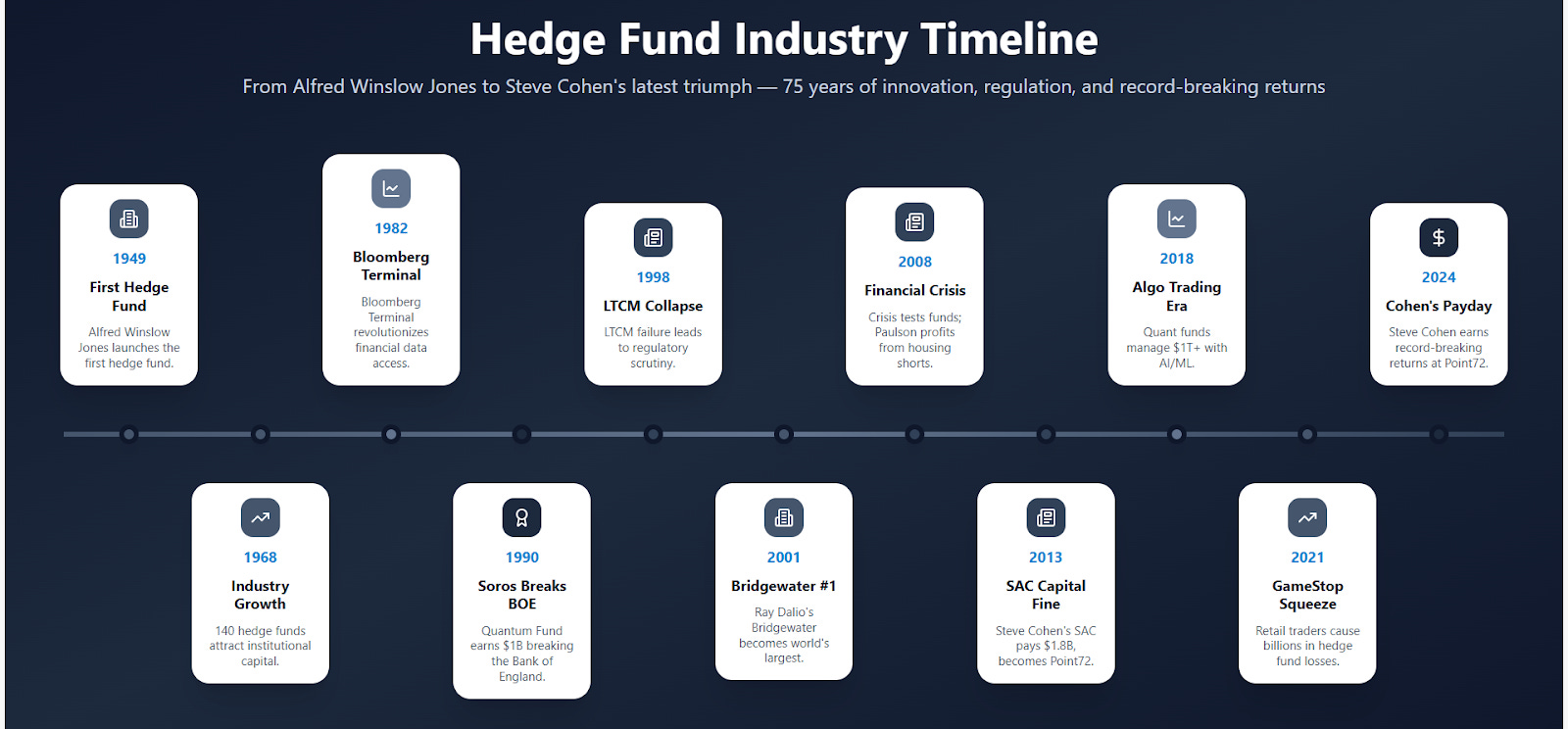
When Information Was Power
There was a time when simply knowing something before everyone else did could make or break a career in finance. Trading floors thrived on phone calls, private tips, and fragmented information. Hedge funds thrived in this environment.
Then technology disrupted everything. The Bloomberg Terminal put real-time financial data in everyone’s hands, forcing hedge funds to rethink the definition of “edge” and alpha generation. The skill today is sorting through good and bad information. Identifying opportunity within a sea of information and data. Being early in an era where everyone is increasingly informed. Easier said than done.
The Technology Shock That Changed Everything
Before Bloomberg, information was fragmented, slow, and costly. Firms that could access the right data first enjoyed a competitive advantage. After Bloomberg, real-time global data became accessible to all professionals. The edge shifted: it was no longer about access but about interpretation and systems.
The Bloomberg Terminal (more on Bloomberg) is a proprietary computer system that provides real time market data, analytics, news, and trading capabilities. Founded by Michael Bloomberg in 1981, the system has become an essential tool for traders, analysts, portfolio managers, and other financial professionals. Users can track equities, bonds, commodities, currencies, and derivatives with live price quotes and market analytics. The terminal provides access to Bloomberg News, proprietary research, and third-party reports, allowing users to stay informed on global financial developments. Professionals can place trades directly through the terminal and manage multi-asset portfolios with pre- and post-trade analytics.
Moreover, the system includes Instant Bloomberg (IB), a secure messaging platform connecting users to a global network of financial professionals. Users can configure dashboards, alerts, and multi-screen layouts to optimize workflow and monitor multiple markets simultaneously. Terminals are leased on an annual basis, with costs typically starting at around $30,000 per user per year. As of recent reports there are over 500,000+ subscribers globally (more on Axios).

The Bloomberg Terminal transformed hedge funds by putting real-time market data, news, analytics, and trading tools directly on every desk, eliminating the information delays that once advantaged only the largest Wall Street institutions. Bloomberg commoditized information advantage, which forced firms to build analysis infrastructure. This was the catalyst for the next era of hedge funds’ transformation. Hedge funds now have to fuse relationship-driven edges and quantitative edges to generate the exceptional returns they are known for.
Today success depends on how a firm processes, analyzes, and acts on information, not just having it. Idea generation is no longer enough.

From Hedge Funds to Capital Platforms
This tech revolution has also spurred another accelerating trend. The lines between hedge funds, venture capital, and asset managers are blurring. Various examples exist today. Thrive Capital is expanding its influence across private and public markets. Hedge funds are now increasingly developing strategies to invest in private companies, whether through venture arms or other means. The upshot is that the next generation of financial institutions will be hybrid intelligence-driven capital platforms, deploying capital across the entire business lifecycle. Lifecycle investors, built to invest across stages, sectors, geographies, markets, and styles.
Let’s dive into some prominent examples reshaping global investing today.
Firm Profiles
Thrive Capital

Joshua Kushner (Source: Fortune), Thrive now manages over $30 billion in AUM (Assets Under Management)
Founder: Joshua Kushner
Description:
Thrive Capital has evolved from a venture firm into a multi-stage capital platform with influence across private and public markets. Known for pairing Silicon Valley access with Wall Street discipline, Thrive built a reputation for concentrated bets on category-defining technology companies in consumer tech, fintech, and AI.
Thrive represents a new model of venture investing: firms building intelligence systems that span private and public markets. The firm is even noted for incubating its own companies, demonstrating how it has become a platform.
Notable Investments: Warby Parker, SKIMS, OpenAI, Stripe, OpenEvidence

(Source: Wikipedia)
“Thrive feels like East Coast rigor meets West Coast ambition — high-conviction investing with Silicon Valley speed.”
Point72 Asset Management

Founder: Steve Cohen
Description:
Point72 represents the evolution of the modern hedge fund into a diversified investment platform spanning public equities, private investments, venture, and quantitative strategies. Built on Cohen’s trading DNA, the firm combines deep fundamental research with aggressive talent acquisition and deep institutional infrastructure and expertise.
Notable Private Investments: Apex, Boulevard, Dashworks, Fever, Knowde
Public Market Focus:
A rotating mix of high-growth technology, AI infrastructure, healthcare innovation, and tactical macro positioning.

(Source: Wikipedia)
“This is a people business. I like to back smart founders with big ideas and give them the runway to change the world. It’s exciting that there is always something new.”
D1 Capital Partners

Founder: Daniel Sundheim
Description:
D1 Capital was built as a crossover fund from day one. Investing across public and private markets with a long-duration, research-intensive approach. Sundheim’s vision was to erase the artificial divide between late-stage venture and public equities, underwriting businesses across their lifecycle from inception to maturity.
Notable Private Investments: Anthropic, OpenAI, SpaceX
Public Market Approach: High-conviction positions in disruptive growth companies, often maintained across IPO transitions.

(Source: Wikipedia)
“They’re not the first people to have the idea to cross over to the private side, they just seem to have done that strategy better than anyone else”
Agentic Alpha: The Future of Investing
Now, imagine a future where the best portfolio managers have teams of agentic researchers scouring millions of data sources to uncover out of consensus views or trends. Imagine a trader being able to execute trades in various different markets as soon as an idea is uncovered. Imagine legal, marketing, and taxes, being all bundled into a few agents, reducing costs drastically across an investment firm.
AI promises to redefine the investing landscape entirely.
This shift is not purely hypothetical. Hedge funds have been experimenting with machine learning for more than a decade. Quantitative firms such as Renaissance Technologies and Two Sigma have long relied on statistical learning models to identify patterns in large datasets, while many discretionary funds now use natural language processing tools to scan earnings calls, regulatory filings, and news sentiment for signals that might move markets. What was once experimental is quickly becoming embedded in daily workflows.
Firms that harness AI successfully will redefine how capital is allocated, compressing traditional advantage cycles and widening gaps between leaders and laggards. AI will accelerate processing speed, trade generation, and execution. It could create a constant feedback loop of information to returns.
Agent-based systems may represent the next step in this evolution. Unlike traditional models that perform a single task, agents can chain together multiple processes: sourcing data, running analysis, testing hypotheses, and even executing trades. In finance, where speed and coordination across research, trading, risk management, and compliance are critical, this kind of modular automation could meaningfully reshape the structure of investment firms. A portfolio manager might deploy specialized agents for macro analysis, company-level research, portfolio optimization, and trade execution, each continuously learning from the results of the others simultaneously.
Alpha today surely is beyond the wildest dreams of Alfred Winslow Jones.
Yet the core principle remains unchanged. The edge in investing has always come from processing information better or faster than competitors. If agentic systems dramatically expand the scale and speed at which information can be analyzed, they may become the next frontier of that advantage in financial markets.
What will the future of edge look like? Time to find out.

If you are an analyst, investor, portfolio manager, or capital allocator working in finance I would love to connect. Please reach out to me to chat at nana.oduronyaning@gmail.com or nana.oduro-nyaning@nidoventures.com
By Nana Oduro-Nyaning
—
More on the importance of The Bloomberg Terminal (Substack)
Great piece Nana