


In November 2025, Michael Burry, the investor who famously shorted the housing market before 2008, turned his attention to something most people have never thought about: depreciation schedules. His accusation was that hyperscalers are minimizing depreciation by artificially prolonging the assumed useful life of their hardware. He called it one of the more prevalent forms of earnings manipulation in contemporary finance. His fund had put options on Nvidia and Palantir to back the thesis (more on CNBC).

The accusation landed with some noise, then mostly faded. But the underlying question didn’t: Are the world’s largest technology companies using accounting assumptions to make their AI investments look more profitable than the underlying economics justify?
Whether or not Burry is right about the motive, the math behind his concern scales to something far larger than any single company. Goldman Sachs estimated in April 2026 that cumulative AI infrastructure investment will reach roughly $7.6 trillion between 2026 and 2031. That number is what makes the depreciation question systemic rather than corporate.
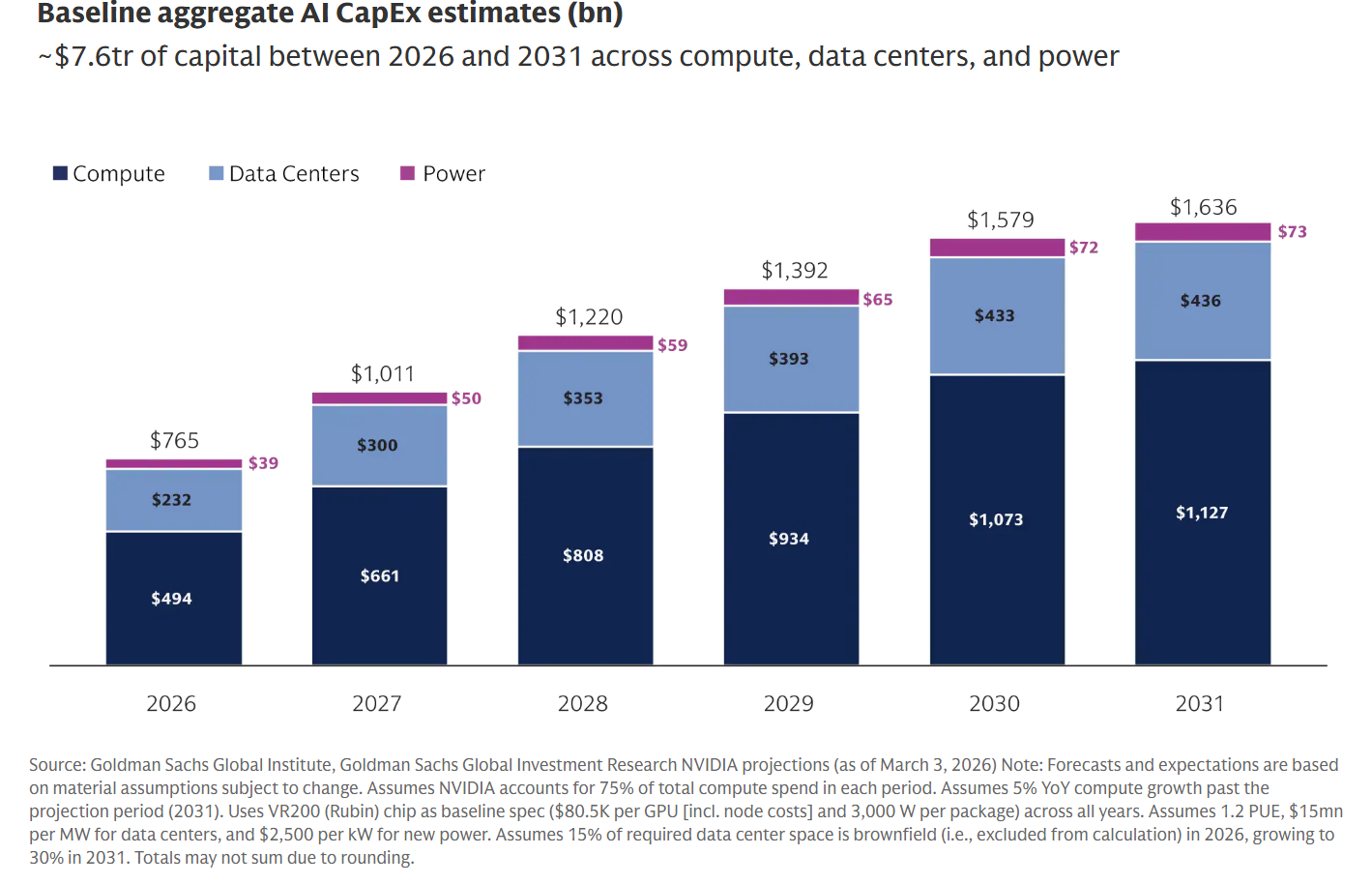
Over the past two years, Microsoft, Google, Meta, and Oracle have extended the assumed useful life of their GPU and server assets, not through press releases or earnings call announcements, but through footnote changes in their annual filings (more on FT). The mechanism is straightforward: longer useful life means lower annual depreciation expense, which means higher reported earnings, without changing a single dollar of actual cash flow. Microsoft moved server life from four to six years. Meta made similar adjustments. Across companies spending tens of billions on AI infrastructure annually, those changes move earnings by billions of dollars, making AI investments look more profitable than the underlying cash economics would suggest.
Then Amazon did the opposite. In 2025, it shortened its server life assumption from six to five years and took a $700 million operating income hit (more on Q4 2024 Amazon Earnings Call). It disclosed the change publicly, absorbed the pain, and moved on. That reversal is worth paying attention to, not because it proves Burry right, but because it shows the assumption can go both ways.
AI hardware cycles are accelerating, not slowing, and Nvidia’s GPU generations are turning over faster than the accounting assumes. If the actual useful life of this infrastructure is shorter than what’s written in the footnotes, the earnings story changes. Not all at once, but gradually, the way most accounting problems surface.
Before evaluating which side is right, it helps to understand exactly how the mechanism works.
Explaining the mechanism
When a company buys servers, the cash goes out on day one. But the cost does not hit the income statement all at once, it gets spread across the asset’s useful life. That annual charge is called depreciation.
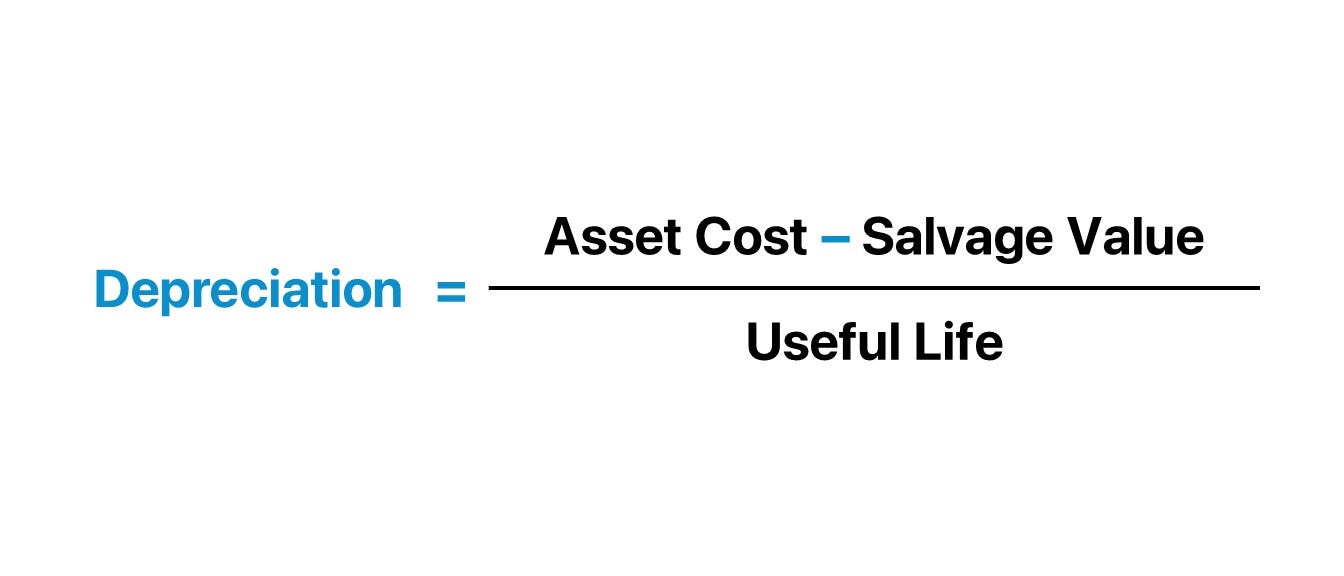
To make this concrete, imagine you are Amazon’s CFO. Nvidia just released its latest chips and you decide to purchase $10 million worth of them. The wire goes out, cash leaves, and PP&E goes up by $10 million. No income statement impact yet. The purchase is an asset, not an expense.

Every year after that, Amazon recognizes the cost of those chips through depreciation expense. That charge reduces reported net income, but because it is a non-cash expense, it gets added back in the cash flow statement. The cash already left on day one.
Now change one number, the useful life assumption, and everything shifts. Four years or six years on the same $10 million purchase produces very different reported profits, while free cash flow stays completely unchanged.
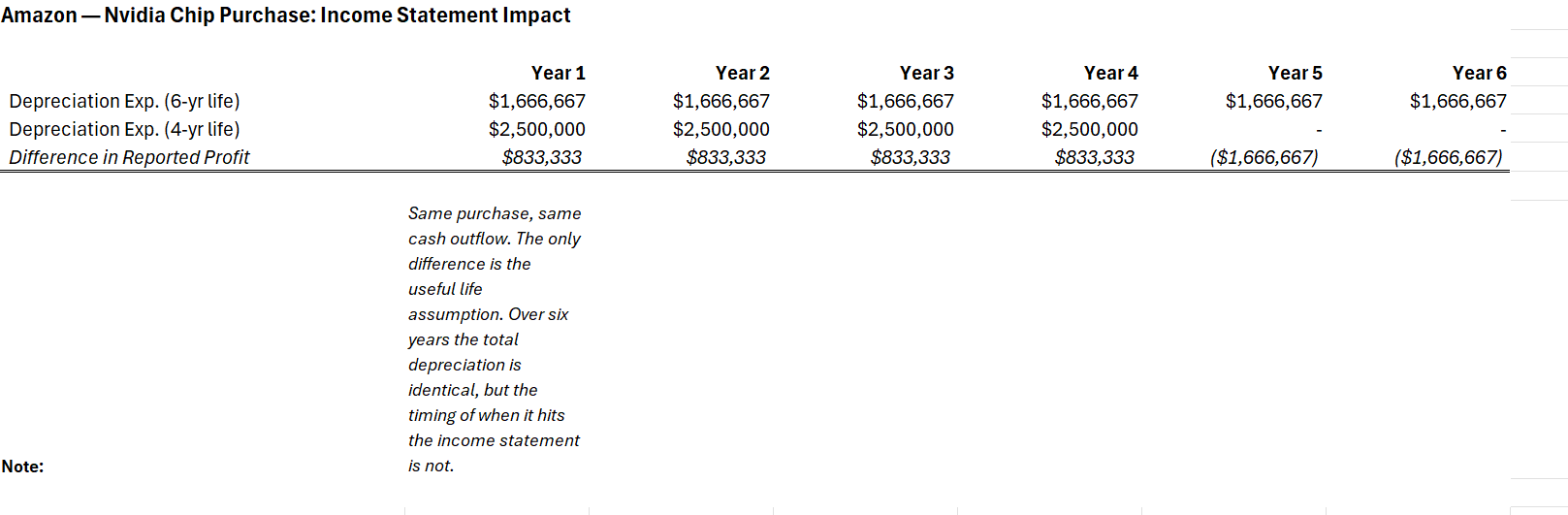
The key thing the table shows is that extending useful life does not make the expense disappear, it borrowsdisappear it borrows profit from the future and moves it to today. Now scale that dynamic to tens of billions in annual AI spend, and you have the story Goldman Sachs flagged in April 2026.
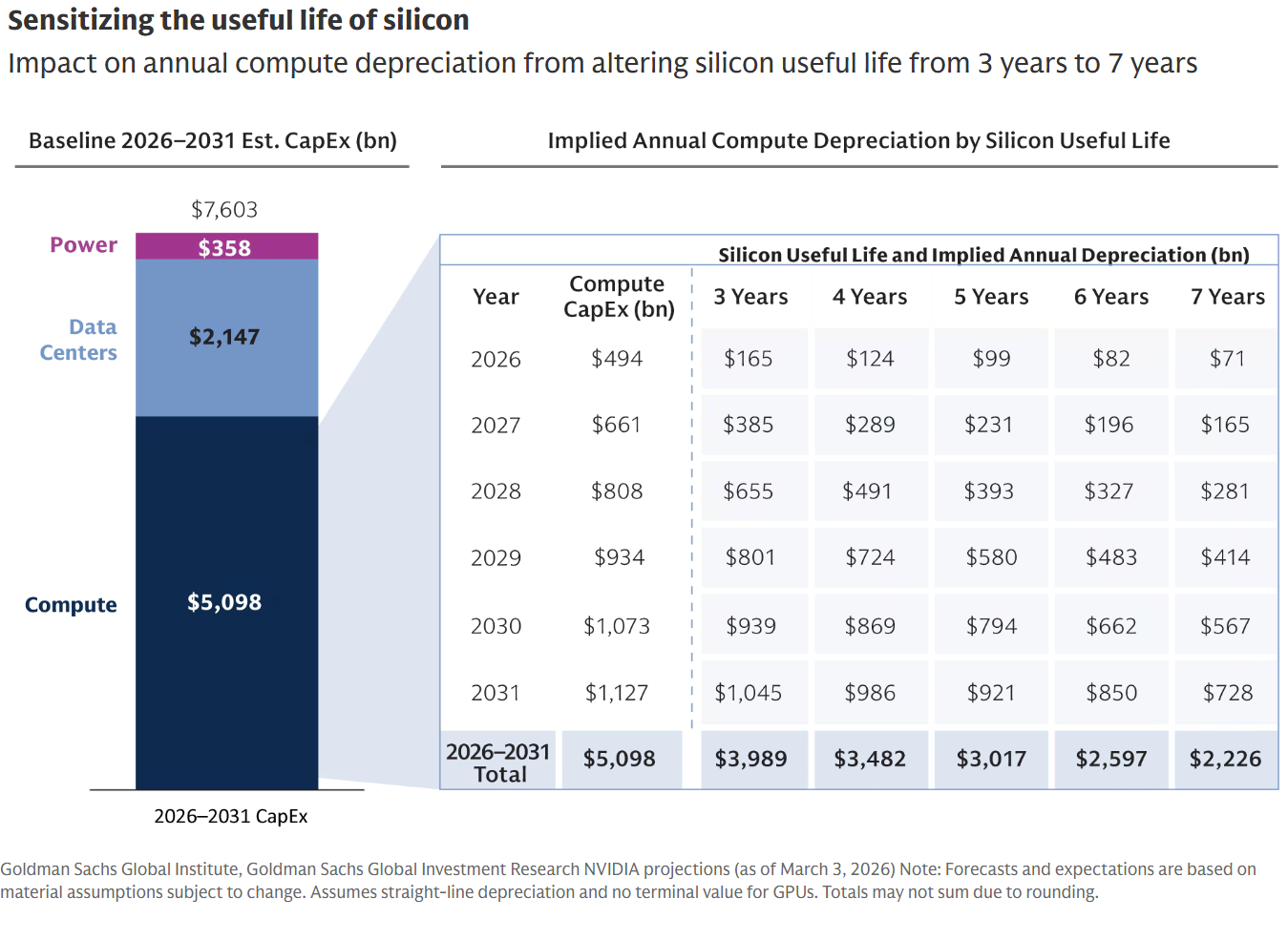
Under GAAP, management sets the useful life estimate. Auditors check whether it is reasonable, they are not verifying how long a GPU actually lasts in a data center. The rules give companies real discretion. The question is whether that discretion is being used to reflect reality or to manage earnings.
The two cases: Microsoft’s extension vs. Amazon’s reversal
In its FY2023 10-K, Microsoft disclosed that it had extended the assumed useful life of its servers and network equipment from four to six years, effective fiscal year 2023 following an assessment completed in July 2022. On the Q4 FY2023 earnings call, Microsoft’s CFO confirmed the practical effect: the change shifted $3.7 billion of depreciation expense out of FY2023 and into future periods. That is $3.7 billion in additional reported profit from a single accounting estimate change.
The other hyperscalers made similar moves. Google extended server life from four to six years in 2023, generating roughly $3 billion in savings over time. Meta moved from a four-to-five-year range to 5.5 years in 2025, reducing depreciation expense by approximately $2.9 billion, around four percent of its pre-tax profit that year. Oracle extended from four to five years in 2023. Each company disclosed the changes in their respective filings, had auditor approval, and none faced a challenge with the SEC.
Then Amazon went the other direction. In January 2024, Amazon had extended its server useful life from five to six years, citing continuous improvements in its hardware, software, and data center designs, joining Microsoft, Google, and Meta in the same direction, toward slower depreciation and higher near-term earnings. A year later, it partially reversed course, announcing it was shortening the useful life of a subset of its servers and networking equipment back to five years, effective January 2025, a move that would cost roughly $700 million in operating income for that year (more on Amazon’s 2025 10-K). The reason came directly from its 2024 10-K: “These two changes are due to an increased pace of technology development, particularly in the area of artificial intelligence and machine learning.”
What makes Amazon’s move interesting is not just that it reversed course, it is that it said why. Four other companies looked at the same hardware, made the same judgment call, and have not changed it. Amazon looked again a year later and decided the answer was different. That gap, one company updating its assumptions while the others hold steady, is exactly what Burry’s argument focuses on.
The Bear vs. Bull cases
Bear Case
In November 2025, Burry went public on X. His core claim was that hyperscalers were understating depreciation to inflate earnings, and that the gap between what the accounting assumed and what the hardware was actually worth would eventually close. He projected a $176 billion understatement across the sector by 2026–2028, with Oracle roughly 26% overstated and Meta roughly 20% overstated by 2028 if current assumptions held. His fund backed the thesis with put options on Nvidia and Palantir.
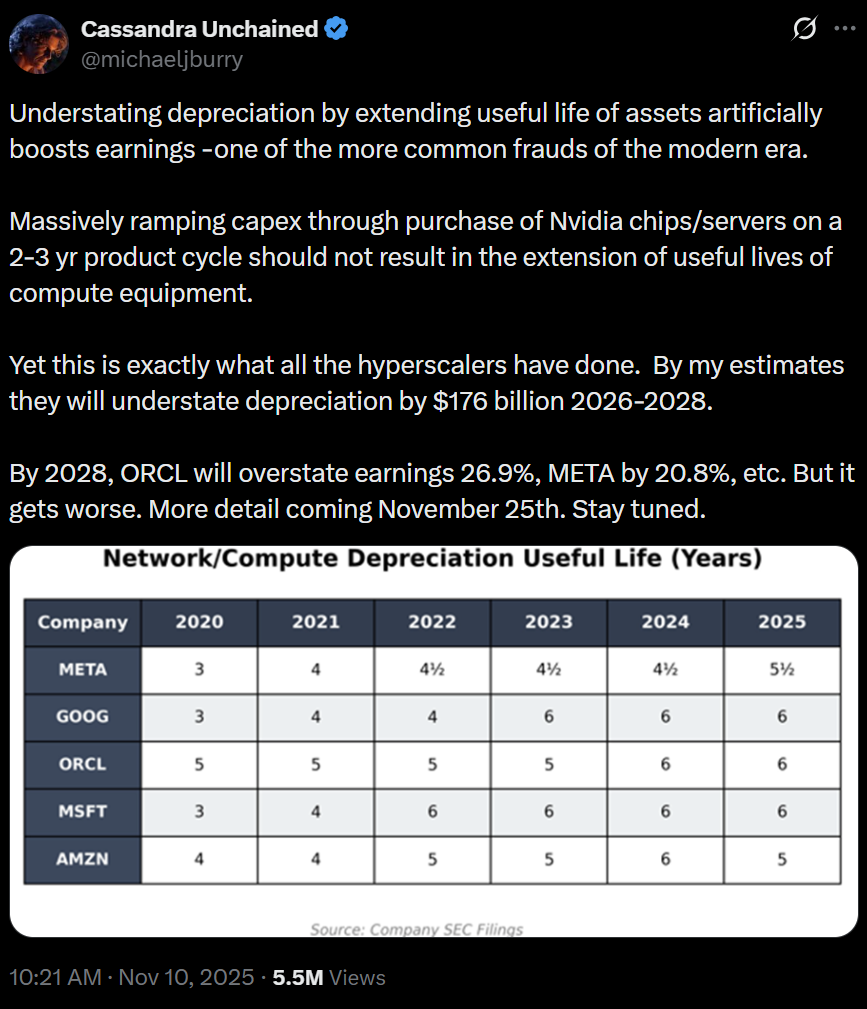
The bear case rests on one point: Nvidia’s GPU generations are not slowing down. Blackwell followed Hopper, and Rubin is coming after Blackwell. Each generation delivers big improvements in performance per dollar, with Blackwell delivering nearly 2x training performance per dollar vs. Hopper, and Rubin set to be 3x faster than Blackwell Ultra (more on Nvidia). This means last year’s hardware loses competitive value faster than any six-year accounting schedule can capture.
If the real replacement cycle is two to three years, the gap between what the balance sheet says the hardware is worth and what the market would actually pay for it widens every quarter. When that gap eventually closes, whether through a useful life revision like Amazon’s or an outright impairment, the income statement takes the hit all at once. No cash impact, but the earnings correction is sudden and visible, and for companies trading at elevated multiples, that is enough to move valuations materially.
That is Burry’s real argument. Not that the cash economics collapse, but that reported earnings have been flattering the business, and the correction, when it comes, will not arrive gradually.
Bull Case
The hyperscalers push back with what they call the value cascade. Older GPUs do not get retired when newer ones arrive. They get redeployed, moving down the workload stack from training, which demands the latest hardware, to inference, which is less compute-intensive and runs efficiently on older chips. An H100 that loses its edge in a training cluster still generates real revenue serving inference requests, powering chatbots, search, and enterprise AI applications.
The market appears to support this. Goldman Sachs noted in its April 2026 report that A100s and H100s still command rental prices consistent with five-to-six-year useful lives, suggesting the secondary market is not pricing in rapid obsolescence. Of course, rental prices reflect current demand, not necessarily what tomorrow’s demand will be once Rubin arrives. But the market is pricing in five-to-six-year lives today.
There is also a transparency argument. Every change discussed in this piece was disclosed in a public filing, reviewed by auditors, and never challenged by the SEC. Amazon’s reversal, rather than undermining the system, is evidence that it works. When the economics changed, Amazon changed the assumption and took the hit publicly. The others have not reversed because, in their judgment, the economics have not changed enough to warrant it.
Beyond the accounting debate, there is another way to test this: look at the actual economics. Free cash flow across the four largest hyperscalers remains strong, ROIC is elevated above 25%, and while Alphabet has tapped debt markets to fund part of its AI spending (more on CNBC), the cash generation across the group has not shown the strain you would expect if the assumptions were dangerously wrong. So far, the economics are holding.
The Bigger Picture
The depreciation debate does not exist in isolation. Goldman Sachs estimates roughly $7.6 trillion in cumulative AI infrastructure investment between 2026 and 2031. At that scale, the useful life assumption is not a footnote detail, it is one of the most consequential variables in the entire AI investment thesis.
This has happened before. Railroad companies in the late 1800s and fiber-optic carriers in the late 1990s both capitalized assets aggressively and depreciated them over timelines that assumed far more durable value than the market ultimately delivered. In both cases the accounting held until it didn’t, and when it broke, it broke through impairment charges that the gradual depreciation schedules had given no warning of. Both buildouts ultimately created infrastructure that lasted. But the accounting corrections were painful, and they arrived suddenly. The parallel for AI is not whether the infrastructure proves useful, it almost certainly will, but whether the useful life assumptions being made today reflect how fast the hardware at the center of it is actually losing competitive value.
The honest position today is that nobody knows whether AI hardware will hold its value for six years or collapse in three. What is knowable is that the assumption matters enormously, that it is being made by management under real competitive pressure to show strong earnings, and that the GPU upgrade cycle will eventually stress-test it.
Amazon already showed what that stress test looks like in practice. It extended, then partially reversed, and took the hit. The others may never need to follow. Or they may, and the correction will arrive the way Amazon’s did, quietly disclosed in a footnote, until the income statement makes it impossible to ignore.